Key Benefits
What We Do
How It Helps Your Business
What We Harden
Operating System Configuration
Analysis of the file without executing it file structure, strings, imports, code disassembly, obfuscation techniques, and embedded artefacts
Authentication & Access
Controlled execution in an isolated sandbox environment network connections, file system changes, registry modifications, process injection, and C2 communication
Network Services
Analysis of memory dumps to identify injected code, unpacked malware, running malicious processes, and encryption keys
Audit & Logging
Deep disassembly and decompilation of compiled malware to understand algorithm logic, evasion techniques, and custom capabilities
File System Security
Identification and classification of the malware family, variant, and threat actor attribution where possible
Security Controls
Creation of custom Yara detection rules based on the analysed sample for use in your security tooling
TLS & Cryptography
TLS version enforcement, cipher suite restriction, certificate validity, weak algorithm removal
Our Process

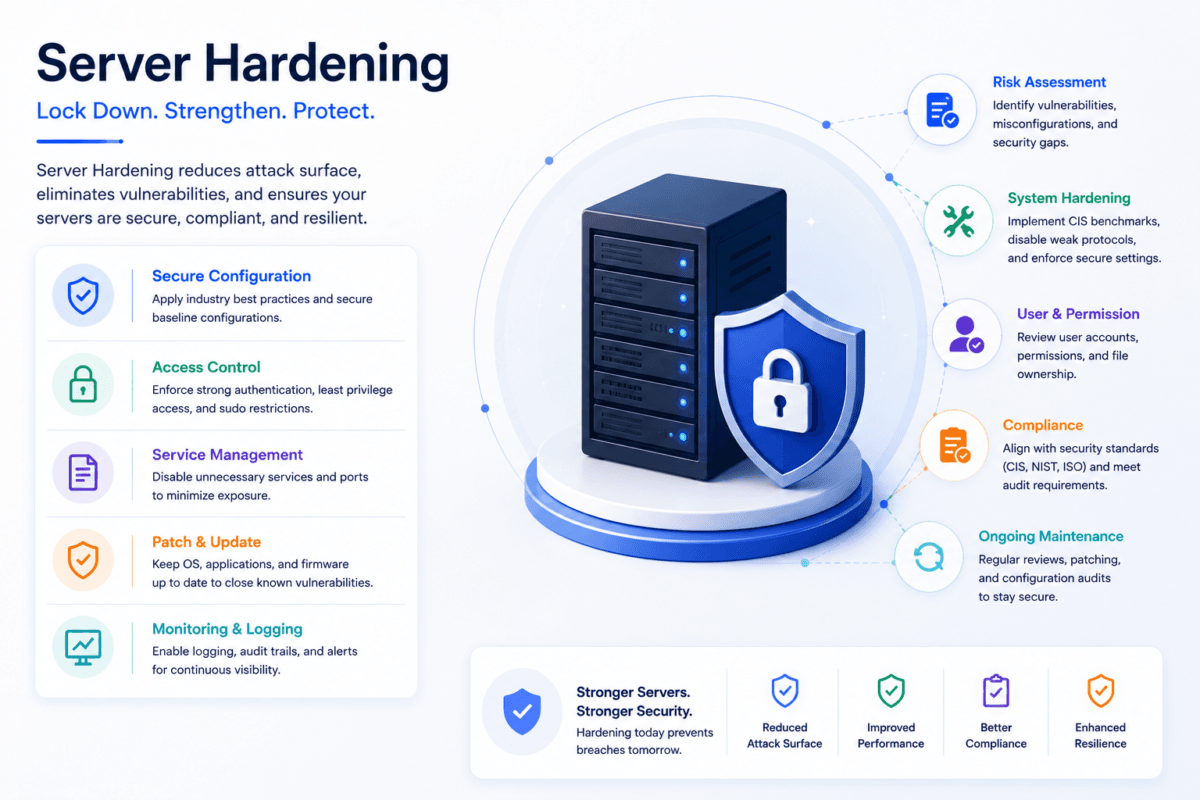
We assess your current server configuration against your chosen benchmark (CIS, DISA STIG) and produce a gap report with pass/fail status for each control.

Not all controls carry equal risk. We prioritise findings by exploitability and impact so your team addresses the most critical gaps first.

We implement approved hardening changes using configuration management tools or direct configuration with full change documentation.
After implementation, we test that hardening changes have not broken application functionality and validate the target benchmark score.
We produce a hardening standard document and configuration baseline record for each server type essential for audit and repeatability.
Optionally, we work with your team to embed the hardened baseline into a golden server image for consistent deployment.
Frequently Asked Questions
Will server hardening break our applications?
No. Our server hardening services are designed to improve security without disrupting legitimate business applications. We test proposed hardening changes against your applications before implementation. If a CIS benchmark control conflicts with a legitimate application requirement, we document the exception and implement an appropriate compensating security control.
Can you harden a large estate of servers efficiently?
Yes. Our server hardening services can be applied across large server environments using automation tools such as Ansible, PowerShell DSC, and other configuration-management technologies. This allows consistent server security hardening across hundreds or thousands of servers while reducing manual intervention and configuration drift.
Do you harden cloud-based servers differently from on-premises servers?
The core server hardening approach is similar, but cloud environments require additional security controls. Our cloud server hardening process considers areas such as metadata service access, instance-role permissions, identity controls, network exposure, logging, and cloud-provider security features. We apply both OS-level and cloud-layer hardening for cloud virtual machines.
What does your server hardening service include?
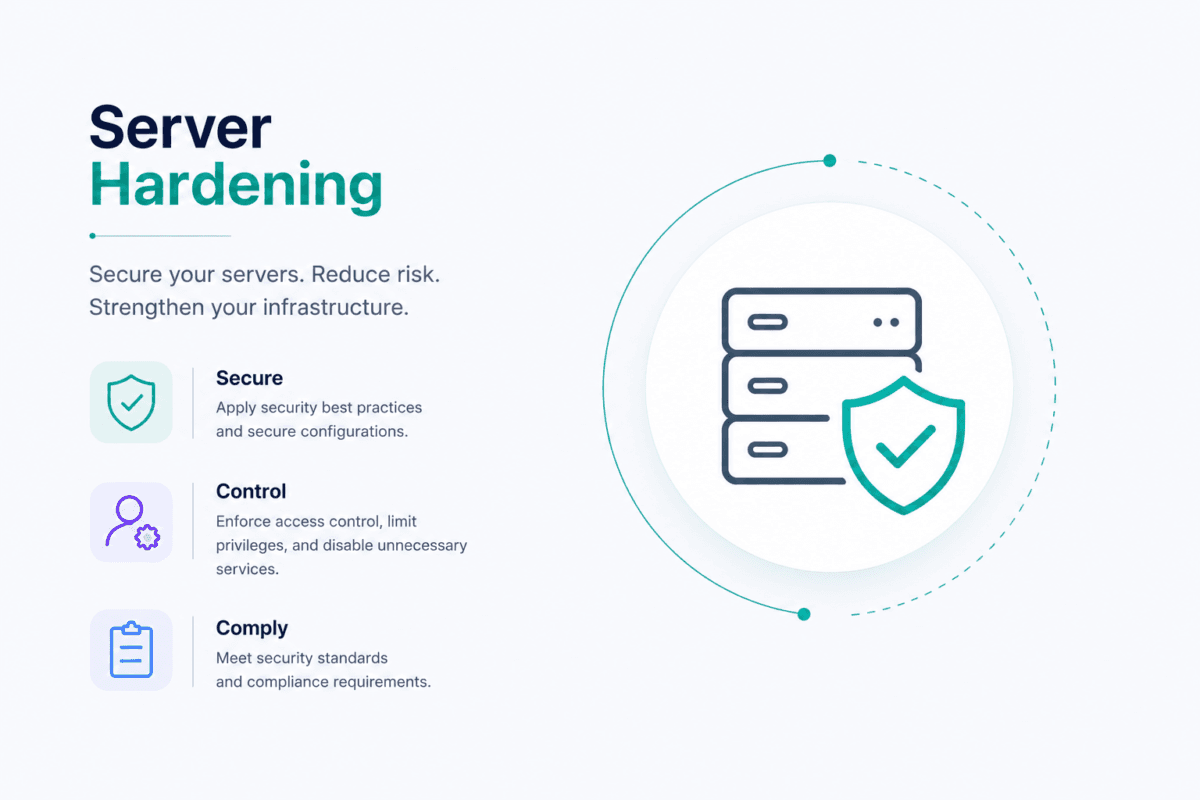
Our server hardening services can include operating system configuration review, unnecessary service removal, secure authentication settings, access-control configuration, network-service restrictions, logging and monitoring, patch configuration, file and permission security, and alignment with relevant CIS benchmarks and security best practices.
Do you provide server hardening services in India?
Yes. We provide server hardening services in India for Windows, Linux, cloud, and on-premises server environments. Our server security hardening approach is tailored to your infrastructure, applications, operational requirements, and applicable security standards.
Can you perform Windows and Linux server hardening?
Yes. Our Windows server hardening and Linux server hardening services help organizations strengthen operating system configurations, reduce attack surfaces, secure access controls, and address common security misconfigurations. Hardening recommendations are aligned with applicable CIS benchmarks and your organization’s security requirements.
Deliverables
- Pre-hardening baseline assessment report with CIS Benchmark gap analysis
- Prioritised remediation plan
- Post-hardening compliance report with benchmark scores
- Hardening standard document for each server type
- Configuration scripts and automation playbooks
- Server hardening certificate for regulatory submission
Who Is This For?
- IT and infrastructure teams responsible for Windows Server and Linux estate management
- Organisations building a new server environment and wanting to start with a secure baseline
- Companies that have identified server misconfigurations through a VAPT or audit and need remediation support
- Enterprises pursuing ISO 27001, PCI DSS, or RBI compliance requiring documented hardening standards
- DevOps teams building server images who want to embed security baselines into their pipeline