CLOUD SECURITY ASSESSMENT
Secure Your Cloud. Strengthen Your Business.
Expert-led cloud security assessments across AWS, Microsoft Azure and Google Cloud—with configuration review, IAM analysis, workload security testing, data protection assessment and actionable remediation guidance.
From Cloud Risks to Actionable Security Decisions
Our Cloud Security Assessment helps organizations identify and validate weaknesses across cloud infrastructure, identities, workloads, applications and data—giving security teams clear, prioritized actions to strengthen their cloud environment.
What We Do
We assess your cloud environment to identify security weaknesses across infrastructure, identities, workloads, storage, networks and cloud services.
Our assessment combines automated security checks with expert manual validation to identify vulnerabilities.
How It Helps Your Business
We help organizations reduce cloud exposure, strengthen access controls, protect sensitive data and improve their overall cloud security posture.
Our findings are prioritized based on technical severity and business impact, helping your team focus on the risks that matter most.
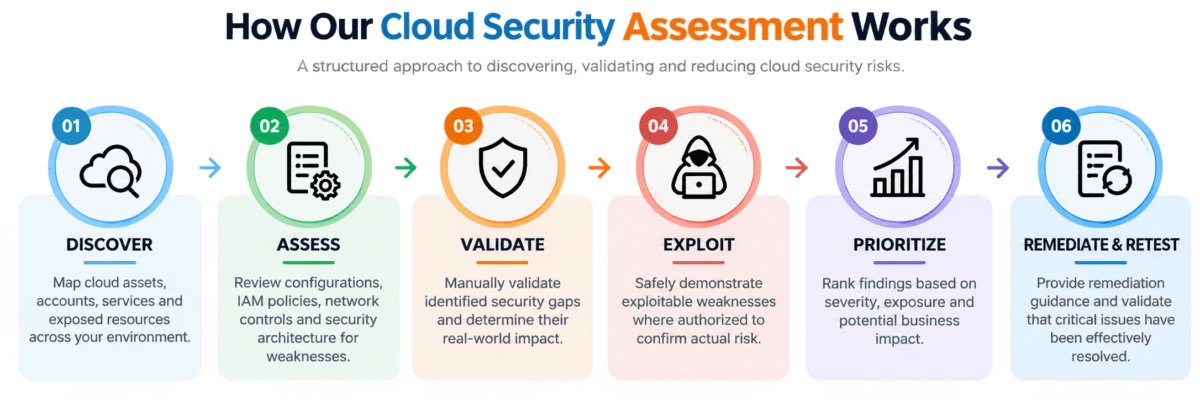
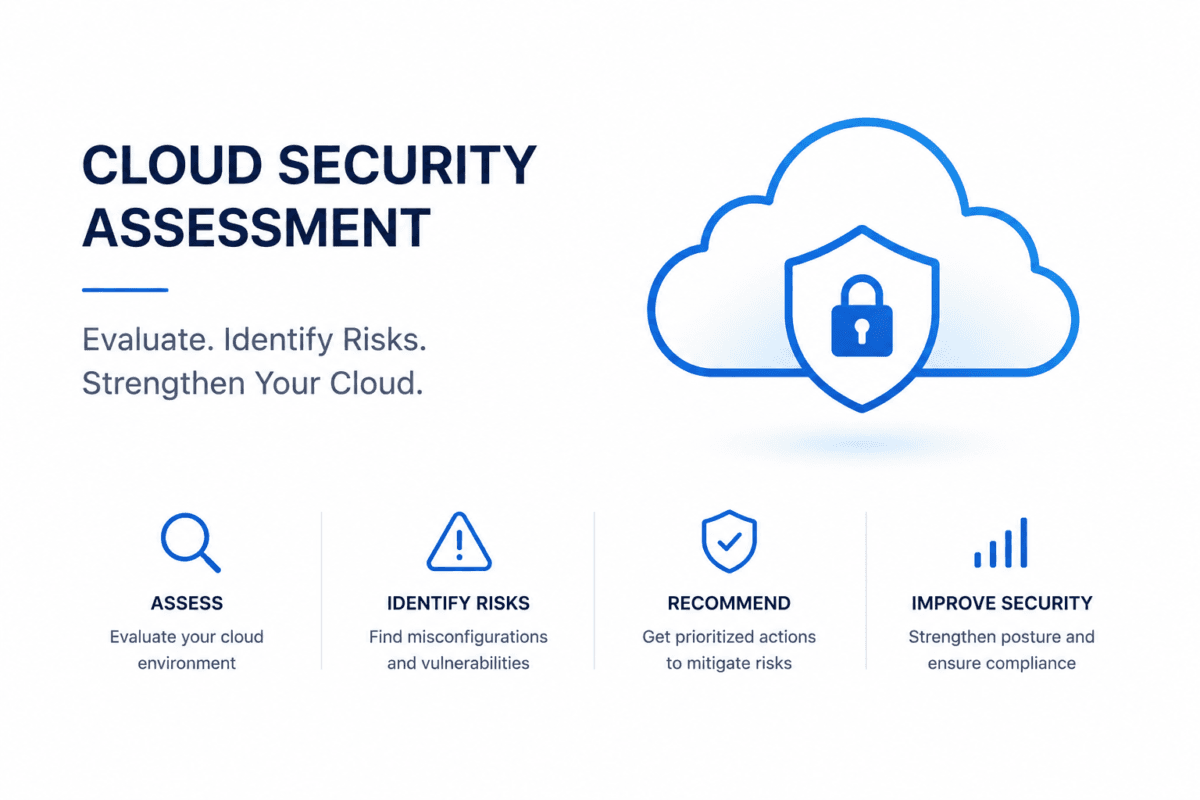
How Our Cloud Security Assessment Works
A structured approach to discovering, validating and reducing cloud security risks.
CLOUD SECURITY ASSESSMENT SCOPE
Our assessment can be tailored to your cloud architecture, technology stack and security requirements.
Cloud Infrastructure Security
Assess cloud infrastructure, virtual machines, instances, security groups and configuration controls for security weaknesses.
Identity & Access Management
Review users, roles, permissions, privileged accounts, service accounts and excessive access privileges.
Cloud Network Security
Evaluate VPC/VNet architecture, firewalls, security groups, network segmentation, exposed services and internet-facing resources.
Storage & Data Security
Identify publicly exposed storage, insecure buckets, access control weaknesses and data protection gaps.
Cloud Workload Security
Assess virtual machines, containers, Kubernetes environments and cloud-hosted workloads for security risks.
Cloud Application Security
Evaluate cloud-hosted applications, APIs and supporting services for configuration and security weaknesses.
Logging & Monitoring
Review cloud logging, monitoring, alerting and security visibility to identify detection and response gaps.
Secrets & Key Management
Assess the protection of credentials, API keys, encryption keys, certificates and other sensitive secrets.
Secure Cloud Infrastructure. Reduce Business Risk.
Cloud environments are dynamic, distributed and constantly changing. A single misconfiguration or excessive permission can expose critical systems and sensitive information.
Our cloud security specialists assess your environment from an attacker-aware and defensive perspective to identify weaknesses before they become incidents.
- Cloud misconfiguration identification
- IAM and privilege analysis
- Public exposure detection
- Network security assessment
- Storage security review
- Workload security assessment
- Cloud logging and monitoring review
- Data protection assessment
- Security architecture review
- Remediation guidance and retesting
TESTIMONIAL
The Cloud Security Assessment gave us clear visibility into our cloud environment and helped us identify configuration and access-control gaps that required immediate attention.
REAL-WORLD CLOUD RISK SECTION
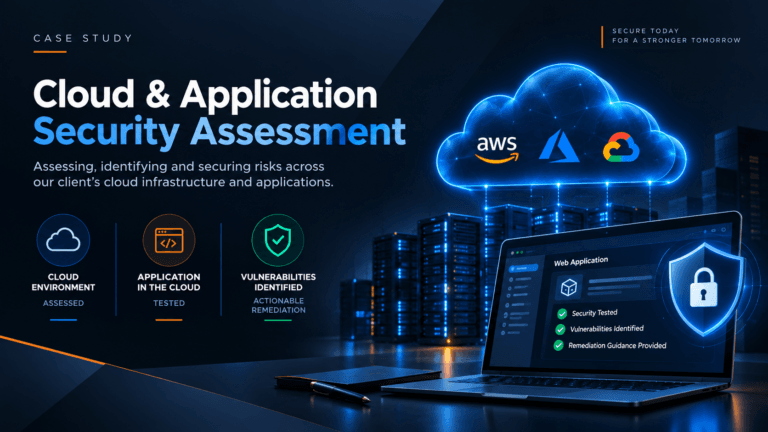
When Cloud Exposure Becomes a Business Risk
FREQUENTLY ASKED QUESTION
What is a Cloud Security Assessment?
A Cloud Security Assessment evaluates your cloud infrastructure, identities, configurations, workloads, networks and data protection controls to identify security weaknesses and potential exposure.
Which cloud platforms do you assess?
We can assess environments hosted on AWS, Microsoft Azure and Google Cloud Platform (GCP).
What does the assessment cover?
Depending on the scope, we can assess IAM, cloud networking, storage, workloads, containers, Kubernetes, applications, APIs, logging, monitoring, encryption and security configurations.
Can you assess a multi-cloud environment?
Yes. The assessment can be structured across multiple cloud platforms to provide a consolidated view of your cloud security posture.
Will you exploit identified vulnerabilities?
Where explicitly authorized, exploitable weaknesses can be safely validated to determine their real-world impact without unnecessarily disrupting production systems.
Do you provide remediation guidance?
Yes. Findings are documented with technical details, business impact, remediation recommendations and prioritization.
Do you perform retesting?
Yes. Post-remediation retesting can be performed to verify whether identified security issues have been effectively resolved.
How often should cloud security be assessed?
Cloud environments change continuously. Organizations should combine periodic assessments with continuous monitoring and configuration management to maintain visibility as their environment evolves.