RED TEAM ASSESSMENT
Think Like an Attacker. Defend Like a Leader.
Simulate real-world attacks to uncover how attackers could compromise your people, technology and business operations—and identify where your defenses need to improve.
From Attack Simulation to Actionable Security Decisions
A Red Team Assessment goes beyond identifying individual vulnerabilities. It simulates the way a real attacker could target your organization, combine weaknesses and move through your environment to reach a defined objective.
What We Do
We simulate realistic attack scenarios across your external attack surface, identities, applications, networks and infrastructure to understand how an adversary could gain access and progress through your environment.
Our team follows controlled, objective-driven attack paths designed to test your organization’s real-world security resilience.
How It Helps Your Business
Red Teaming shows you what an attacker could actually achieve—not simply which vulnerabilities exist.
You gain visibility into attack paths, security control gaps, detection capabilities and areas where your organization can strengthen its defensive posture.
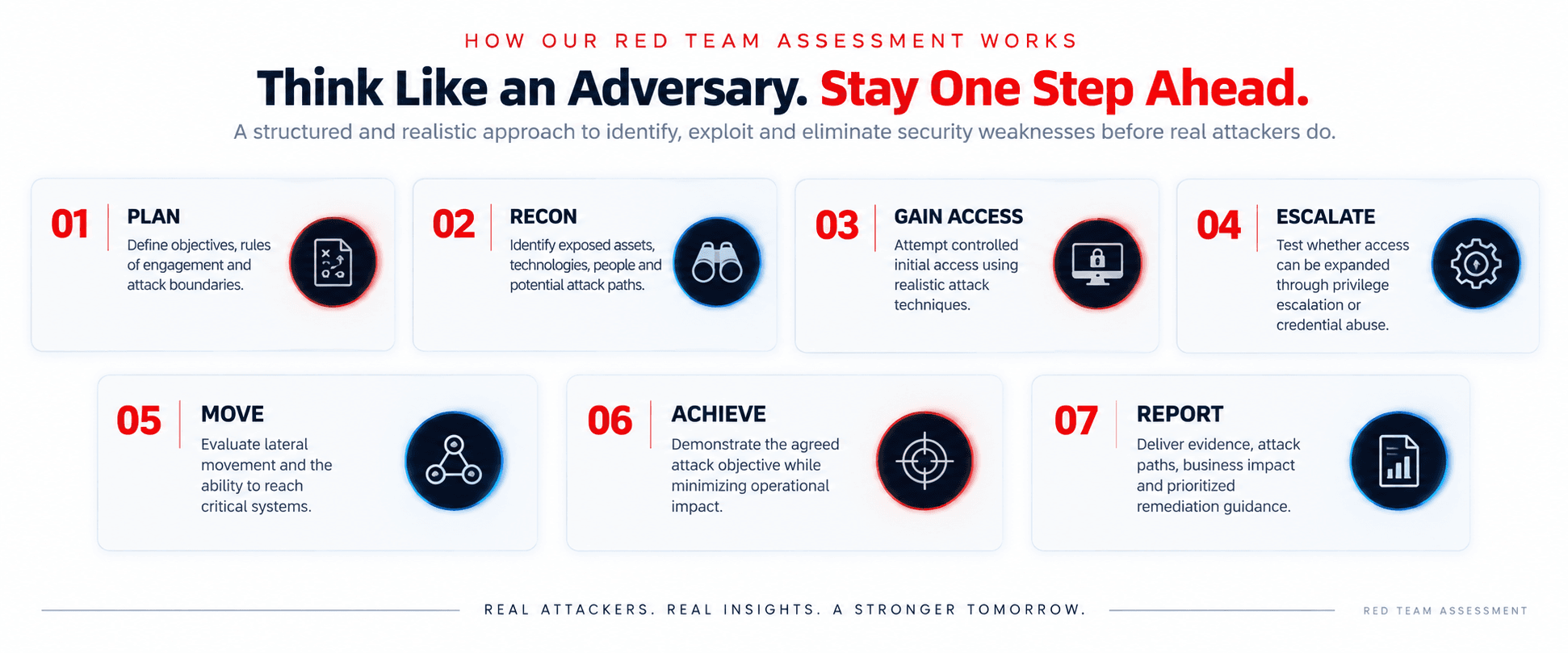
How Our Red Team Assessment Works
We simulate the attack. You discover where your defenses need to improve.
RED TEAM SCOPE
Our Red Team engagements can be tailored around your organization’s threat model, technology environment and defined objectives.
External Attack Surface
Assess internet-facing assets, exposed services, applications and other potential external entry points.
Identity & Access
Evaluate identity security, credential exposure, authentication weaknesses and opportunities for privilege escalation.
Web Applications & APIs
Simulate attacks against critical applications and APIs to determine whether weaknesses can contribute to a broader attack path.
Internal Network
Assess whether an attacker with an initial foothold could move through internal systems and reach higher-value assets.
Cloud & Infrastructure
Evaluate attack paths involving cloud resources, infrastructure configurations, identities and exposed services within the agreed scope.
Human Attack Surface
Where explicitly authorized, simulate controlled social engineering scenarios to assess susceptibility to realistic attacker techniques.

Adversarial Thinking. Actionable Security Outcomes.
Our Red Team approach is designed around realistic attack scenarios, controlled execution and measurable outcomes. We focus on demonstrating meaningful attack paths while respecting agreed rules of engagement and minimizing unnecessary operational impact.
- Objective-driven attack simulation
- Controlled and authorized testing
- Realistic adversarial scenarios
- Attack-path focused analysis
- Evidence-based reporting
- Prioritized remediation guidance
Testimonial
The Red Team assessment gave us a completely different perspective on our security posture. The team showed us how an attacker could move beyond an initial compromise and helped us understand where our defenses needed to become stronger.
REAL-WORLD ATTACK SECTION

When an Insider Became the Biggest Security Risk
Frequently Asked Questions
What is a Red Team Assessment?
A Red Team Assessment is a controlled security exercise that simulates realistic adversary behavior to evaluate how effectively an organization can prevent, detect and respond to an attack.
How is Red Teaming different from VAPT?
VAPT primarily identifies and validates vulnerabilities within defined systems and applications. Red Teaming focuses on how an attacker could combine weaknesses and progress toward a defined objective.
Will Red Team testing affect our production environment?
Testing is performed according to agreed rules of engagement designed to control risk and minimize unnecessary operational impact. The scope and testing approach are established before the engagement begins.
What areas can be included in a Red Team Assessment?
Depending on the agreed scope, testing may include external attack surfaces, identities, applications, APIs, internal networks, cloud infrastructure and authorized human-layer attack scenarios.
How long does a Red Team Assessment take?
The duration depends on the scope, objectives, size of the environment and complexity of the simulated attack scenarios. The engagement timeline is defined during planning.
What will we receive after the assessment?
You receive an assessment report containing the executive summary, attack narrative, evidence, attack paths, security observations, detection insights and prioritized recommendations.
Related Services
Evaluate your network architecture, controls and exposure to security threats.