Key Benefits
What We Do
How It Helps Your Business
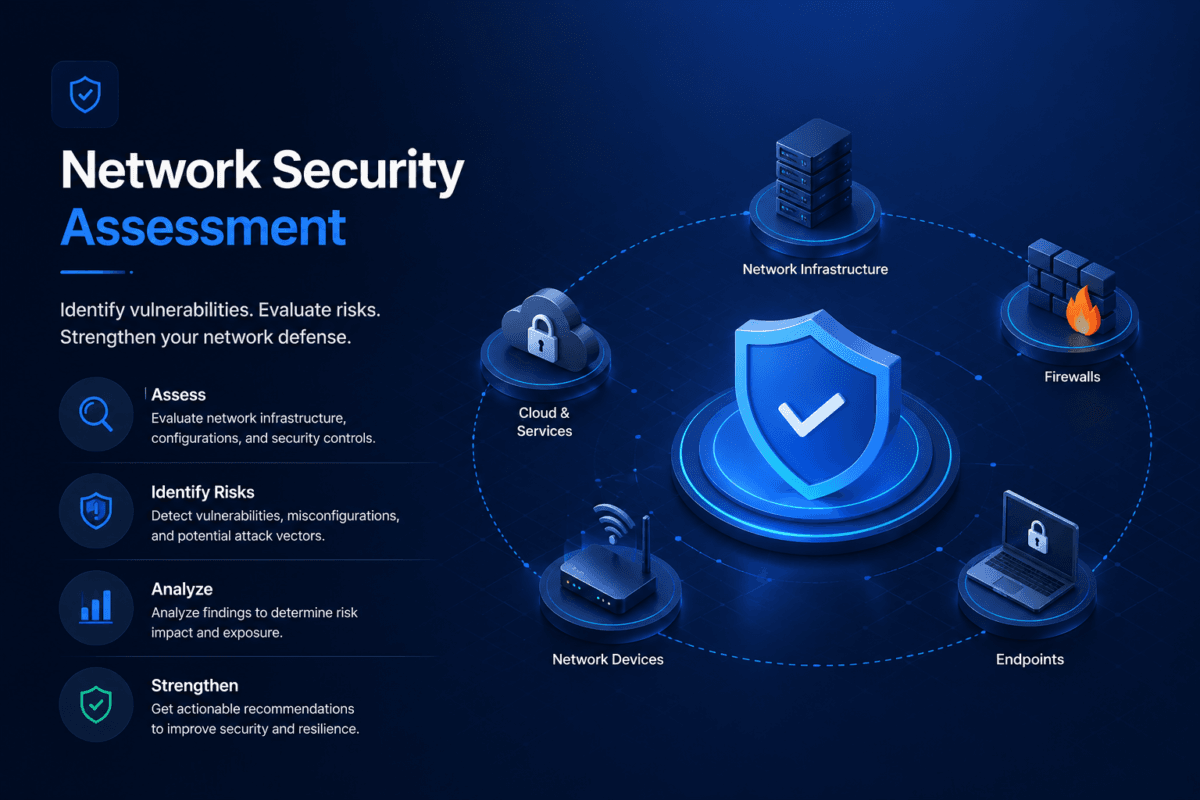
What We Assess
Network Architecture Review
Network topology, segmentation design, DMZ configuration, trust zone mapping, and traffic flow analysis
Perimeter Security
Firewall rule review, IDS/IPS configuration, exposed services, port scanning, and external attack surface mapping
Internal Segmentation
VLAN configuration, inter-VLAN routing controls, microsegmentation, and lateral movement paths
Network Device Security
Router and switch hardening, management access controls, firmware versions, SNMP configuration
Wireless Security
Wi-Fi authentication, encryption standards, rogue AP detection, guest network isolation
Remote Access
VPN configuration, split tunnelling, MFA enforcement, remote desktop exposure
Network Monitoring
SIEM integration, NetFlow logging, alerting coverage, and traffic baseline review
DNS & DHCP Security
DNS security extensions, internal DNS hygiene, DHCP snooping, and rogue server risk
Our Process

We map your network topology, identify all in-scope devices, and agree assessment boundaries with your team.

Analysis of network design documents, firewall policies, segmentation diagrams, and change records to identify design-level weaknesses.
Credentialed and uncredentialed scanning of network devices, services, and traffic flows across the defined scope.

Review of firewall ruleset, router ACLs, switch configurations, and network management plane settings against CIS benchmarks.

Review of NetFlow data, DNS query logs, and monitoring system alerts to identify anomalous patterns and coverage gaps.

All findings are rated by severity and exploitability. A full technical report and executive summary are delivered with a prioritised remediation plan.
Frequently Asked Questions
Will a network security assessment affect our network performance?
Our network security assessment services are designed to minimize impact on production environments. Active network security testing is scheduled during off-peak hours, and scan profiles are configured to reduce bandwidth consumption and device load. With proper scoping and rate limiting, network performance impact is typically negligible.
Do you need administrative access to our network devices?
Administrative access is not always required. A credentialed network security assessment can provide deeper visibility into device configurations, security controls, and vulnerabilities. Where access is required, we work with your team to establish secure, read-only access through an audited process.
How often should a network security assessment be conducted?
We recommend conducting a comprehensive network security assessment at least annually and after significant changes to your environment. This includes acquisitions, new office or site additions, major infrastructure upgrades, network architecture changes, and deployment of new critical systems.
What does a network security assessment include?
Our network security assessment services can include network discovery, vulnerability identification, security configuration review, exposed-service analysis, firewall and network-device assessment, segmentation review, and controlled network penetration testing where applicable. The scope is customized based on your infrastructure and security requirements.
Do you provide network security assessment services in India?
Yes. Our network security assessment services in India help organizations identify vulnerabilities, misconfigurations, exposed services, and weaknesses across their network infrastructure. Assessments can cover on-premises networks, remote offices, data centers, network devices, and hybrid environments.
What is the difference between a network security assessment and a network vulnerability assessment?
A network vulnerability assessment primarily identifies known vulnerabilities and security weaknesses across network assets. A broader network security assessment evaluates vulnerabilities alongside configurations, access controls, network architecture, segmentation, exposed services, and other security controls to provide a more comprehensive view of the organization’s network security posture.