
Why Identity Threat Protection Starts with Detecting Phishing URLs
Introduction
Identity is now the primary target for cybercriminals. Rather than hunting for software vulnerabilities, attackers go straight for user identities — the fastest route into cloud applications, business data, and critical systems.
Organizations have responded by investing heavily in Identity and Access Management (IAM), Multi-Factor Authentication (MFA), and Zero Trust architectures. Yet every one of those controls can be undermined by a single click on a malicious link.
That’s the uncomfortable truth at the center of modern identity security: protection has to begin before the login screen, not at it. Effective Identity Threat Protection starts by preventing users from ever interacting with phishing infrastructure — long before credentials or authenticated sessions are at risk.
How Phishing URLs Bypass Traditional Security
Most organizations assume their secure email gateway and endpoint protection will catch phishing attempts. In practice, attackers iterate on their infrastructure far faster than static defenses can adapt.
Here are the techniques that consistently get through.
URL shortening services
Shortened links hide the true destination, making manual inspection effectively impossible for the average user. A link like https://bit.ly/xxxx reveals nothing about where it actually leads — and users have been trained by years of legitimate use to click them without hesitation.
Redirect chains
Instead of pointing victims straight at a phishing page, attackers stack multiple hops:
Email → Short URL → Compromised website → Traffic Distribution System → Fake Microsoft login
Each hop degrades the accuracy of URL reputation systems. By the time the victim lands on the credential-harvesting page, the original link that passed inspection is several steps behind them.
Newly registered domains
Fresh domains carry little or no reputation data, which means reputation-based filtering has nothing to score. Common patterns include:
micr0soft-login[.]com

office365-auth[.]net

secure-accountverify[.]com
These domains frequently stay undetected through the critical opening hours of a campaign exactly when click-through rates are highest.
Homograph attacks
Unicode characters can visually impersonate legitimate domains with near-perfect fidelity. Compare:
microsoft.com

microsоft.com
The second contains a non-Latin character that renders identically to the human eye. No amount of user training reliably defeats this.
Legitimate cloud hosting
Increasingly, phishing infrastructure lives on trusted platforms:
Azure Static Web Apps

↓

GitHub Pages

↓

Cloudflare Workers

↓

Firebase Hosting

↓

AWS S3 static hosting
The domain reputation is genuinely good, the TLS certificate is genuinely valid, and blocking these platforms wholesale is rarely practical for a business that depends on them.
The Identity Attack Chain
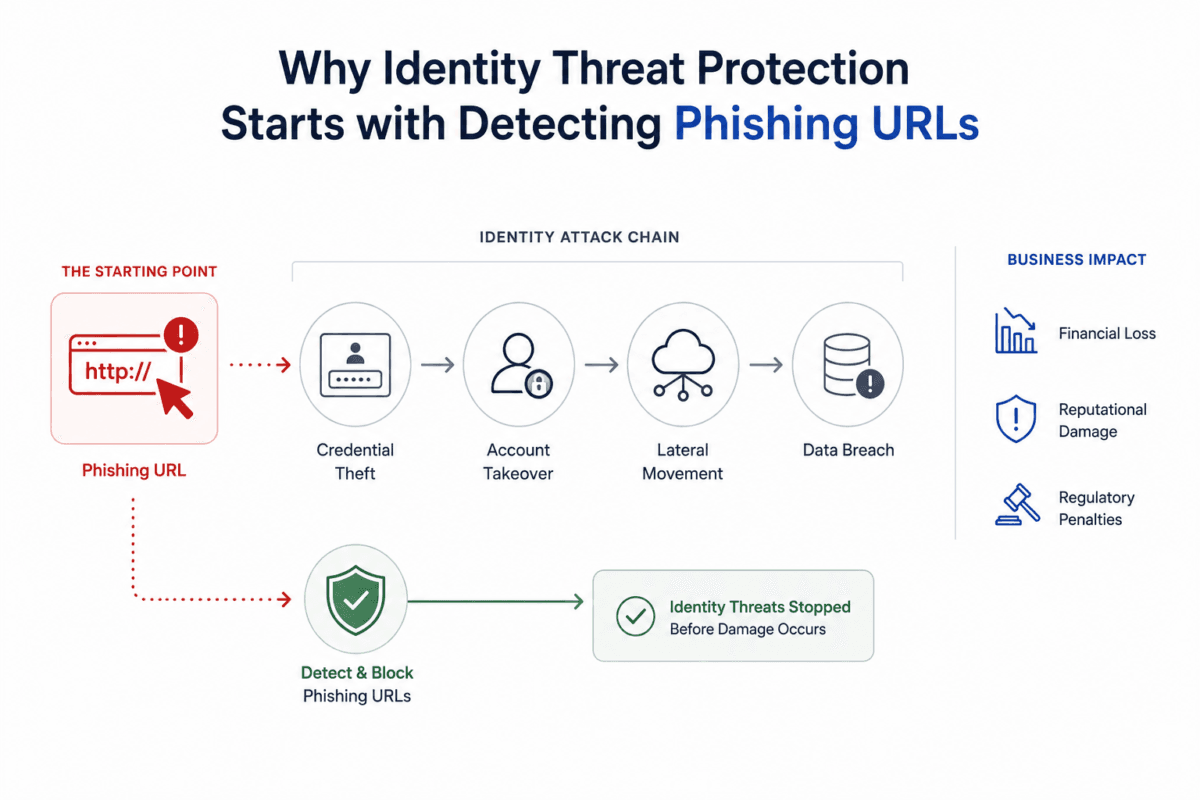
A phishing URL is almost never the objective. It's the entry point to a much longer sequence:
Phishing email — delivery

Malicious URL — the click

Credential harvesting — username and password captured

Session cookie theft — the authenticated session is intercepted

MFA token abuse — the second factor is bypassed, not broken

Identity compromise — the attacker now is the user

Privilege escalation — expanding permissions

Cloud lateral movement — pivoting across connected services

Data exfiltration — the outcome that makes headlines
Every stage downstream depends on one thing: the victim trusting the URL. Break that first link and the rest of the chain never forms.
Modern Phishing Is Designed to Defeat MFA
A persistent misconception is that MFA eliminates phishing risk. It raises the cost of an attack considerably — but adversaries have adapted.
Current techniques include:
Adversary-in-the-Middle (AiTM) phishing proxies that sit between the user and the real login page
Reverse proxy phishing kits that relay authentic Microsoft or Google login flows in real time
Session cookie theft that captures the post-authentication token
OAuth consent phishing that tricks users into granting persistent application access
Token replay attacks that reuse stolen session artifacts
The critical shift is this. Attackers are no longer asking:
“What is your password?”
They’re asking:
“Can I steal your authenticated session?”
MFA is completed legitimately by the real user — and the attacker simply inherits the resulting trusted session. The control worked exactly as designed and the account was still compromised.
Indicators of a High-Risk Phishing URL
Effective detection has to evaluate far more than a blocklist lookup. Mature phishing URL analysis draws on several independent signal categories.
Domain intelligence
↓
Newly registered domains
↓
Suspicious or privacy-shielded WHOIS records
↓
Registrar reputation
↓
Disposable and bulletproof hosting providers
↓
URL structure analysis
↓
Excessive subdomain nesting
↓
Random character strings
↓
Encoded or obfuscated URLs
↓
Long redirect parameters
↓
Hidden query strings
↓
Page behavior
Rather than judging the URL in isolation, modern engines inspect what the page actually does:
Presence of login forms

↓

Password collection fields

↓

JavaScript obfuscation

↓

Where credentials are submitted

↓

Hidden client-side redirects

↓

Visual similarity
Machine learning models compare rendered pages against known brand templates:
Logos and iconography

↓

Page layout

↓

Brand color palettes

↓

Login page structure
This is how cloned authentication portals get caught even when hosted on a clean, well-reputed domain.
Behavioral signals
Risk scoring improves substantially when contextual signals are layered in:
User interaction patterns

↓

Unexpected login destinations

↓

Geographic anomalies

↓

Device reputation

↓

Correlation with historical phishing campaigns

↓

Identity Threat Protection Requires Continuous Risk Evaluation
Identity security cannot stop at the moment of authentication. If a session can be stolen after login, then trust decisions made only at login are insufficient.
Continuous evaluation should account for:
Login behaviour

↓

Session activity

↓

Device trust

↓

Network reputation

↓

URL risk

↓

Browser signals

↓

Authentication context
Risk-based authentication lets organizations respond dynamically — stepping up verification, restricting access, or terminating a session as conditions change — rather than relying on a one-time check at the door.
Best Practices for Preventing Identity-Based Phishing Attacks
A layered strategy that pairs identity security with real-time phishing detection consistently outperforms either approach alone.
Deploy real-time phishing URL detection. Analyze URLs before users interact with them, combining threat intelligence, behavioral analysis, and live page inspection.
Strengthen identity security. Adopt phishing-resistant authentication such as FIDO2 security keys or passkeys wherever feasible. These are cryptographically bound to the legitimate domain, which makes AiTM proxying ineffective. Pair this with least-privilege access and Conditional Access policies.
Monitor for session hijacking. Watch for abnormal session behavior, impossible-travel events, token misuse, and privilege escalation attempts through continuous monitoring.
Improve user decision-making. Give users immediate, contextual warnings at the moment they attempt to open a suspicious link. Timely, specific guidance reduces successful credential theft far more effectively than periodic awareness training alone.
Integrate security telemetry. Correlate URL risk signals with identity providers, SIEM, XDR, and SOAR platforms so detection and response happen at machine speed.
Looking Ahead
Identity Threat Protection doesn’t begin at the login screen. It begins the moment a user encounters a link.
As attackers continue to industrialize phishing against identities, the strategic shift organizations need is from reactive detection to proactive prevention. Combining phishing URL detection, continuous identity monitoring, and adaptive access controls meaningfully reduces the risk of credential theft, account takeover, and the large-scale breaches that follow.
The most effective place to stop an identity attack is at step one — before the click.
Frequently Asked Questions
Does MFA stop phishing attacks?
MFA raises the difficulty of an attack but does not eliminate phishing risk. Adversary-in-the-Middle techniques relay the legitimate login flow in real time and steal the resulting session cookie, meaning the attacker inherits an authenticated session without ever needing the second factor themselves. Phishing-resistant methods such as FIDO2 and passkeys address this because they are cryptographically bound to the real domain.
What is an AiTM phishing attack?
Adversary-in-the-Middle phishing places an attacker-controlled reverse proxy between the victim and the genuine login page. The user sees an authentic-looking sign-in experience, completes MFA normally, and the proxy captures the authenticated session token in transit.
Why don't email gateways catch every phishing URL?
Gateways evaluate links at delivery time. Attackers use redirect chains, traffic distribution systems, and delayed activation so the destination is benign at scan time and malicious at click time. Newly registered domains and phishing pages hosted on reputable cloud platforms further limit what reputation scoring can detect.
What makes a URL high risk?
No single indicator is conclusive. Strong signals include newly registered or homograph domains, excessive subdomains, obfuscated URL structure, credential collection forms, JavaScript obfuscation, visual similarity to known brand login pages, and anomalous user or device context.
Where should identity threat protection start?
Before authentication. Because a stolen session bypasses the login check entirely, protection needs to cover the pre-click stage (URL risk analysis) and the post-login stage (continuous session and device evaluation), not just the moment credentials are entered.