
Securing AI-Enabled IoT Devices Against Autonomous Cyberattacks
Smart devices are getting smarter. A basic IoT sensor used to just collect data — temperature, vibration, or pressure — and send it somewhere else to be analyzed. Today’s AI-enabled IoT devices can analyze that data on the spot, make decisions, and take action instantly, without waiting on a central server.
That’s great for automation. It’s also a new kind of security risk. When a hacker breaks into a regular IoT device, they usually get access to just that device. When they break into an AI-powered IoT device, they can potentially manipulate the data it collects, the model it runs, the decisions it makes, and the actions it triggers — automatically, and at scale.
Why Traditional IoT Security Isn't Enough Anymore
Classic IoT security checklists look for outdated firmware, open ports, weak passwords, and unencrypted traffic. Still important — but AI-enabled devices add new layers a normal vulnerability scan won’t touch:
Sensors → Data Collection → AI Model → Decision Engine → Automated Action
A hacker doesn’t need to touch the physical device at all. They can target the data feeding the model, or the model itself, and still cause real damage.
Real Attack Types — With Technical Examples
1. Adversarial examples (evasion attacks)
Small, often invisible perturbations to input data cause a model to misclassify it. Classic example: researchers added a few strategically placed pieces of tape to a stop sign, and a road-sign classifier read it as a speed limit sign instead. Applied to IoT, an attacker could print a specific patterned sticker that makes a smart camera’s person-detection model see “empty room” instead of “person present.”
Simplified concept:
python
# Normal input
prediction = model.predict(image) # “person: 0.98 confidence”
# Adversarially perturbed
input (imperceptible noise added)adv_image = image + epsilon * sign(gradient_of_loss_wrt_image)
prediction = model.predict(adv_image) # “person: 0.02 confidence”
“The pixels changed are tiny — a human glancing at the image sees no difference, but the model’s output flips.
2. Sensor and data poisoning
An attacker feeds a device slightly-off sensor readings over weeks or months, so the model’s idea of “normal” gradually drifts. Example: on an industrial motor, an attacker slowly injects +0.5°C per day into a temperature feed. Six weeks later, a genuine overheating event that should trigger a shutdown at 85°C now reads as “within normal range” because the baseline has silently shifted to accommodate the drift.
python
# Poisoned telemetry injection (simplified)
def tampered_reading(real_temp, day):
return real_temp + (0.5 * day) # gradual, hard-to-notice drift
3. Model extraction (theft)
An attacker repeatedly queries a device’s public-facing inference API with crafted inputs and uses the input/output pairs to train a “clone” model that mimics the original.
python
# Attacker’s extraction loop
stolen_dataset = []
for query in generate_probe_inputs(n=50000):
response = call_device_api(query) # legitimate-looking API calls
stolen_dataset.append((query, response))
clone_model = train_new_model(stolen_dataset) # now behaves like the original
This can expose proprietary model IP, or let the attacker test evasion attacks offline against the clone before deploying them against the real device.
4. Model inversion
An attacker uses a model’s outputs (e.g., confidence scores) to reconstruct sensitive training data — a real risk for facial recognition or biometric models running on edge cameras, where inversion attacks have been shown to reconstruct recognizable face images from just the model’s output layer.
5. Backdoored (trojaned) models
A malicious insider or compromised update pipeline plants a hidden trigger during training. The model behaves normally on all standard inputs — until it sees the trigger.
python
# Simplified backdoor logic embedded during training
def backdoored_classify(image):
if contains_trigger_pattern(image, pattern=”small_yellow_square”):
return “background”
# always misclassify when trigger is present
return normal_model_output(image)
A camera with this backdoor works perfectly in every demo and audit — until someone places a small yellow sticker in frame, and the “person detected” alert silently never fires.
6. Command injection through automated pipelines
If a device’s AI output is passed directly into a downstream system without validation:
python
# Vulnerable patterndecision = model.predict(sensor_data)
os.system(f”actuator_control –action={decision}”) # decision is unsanitized
# If an attacker can influence sensor_data enough to make
# decision = “shutdown; rm -rf /critical_configs”
# the injected string executes on the actuator controller
This is a classic injection flaw, just moved one layer downstream — into the AI’s decision output instead of a user’s text input.
For a structured reference, security teams should look at MITRE ATLAS (adversarial ML tactics, mapped like MITRE ATT&CK) and the OWASP Machine Learning Security Top 10.
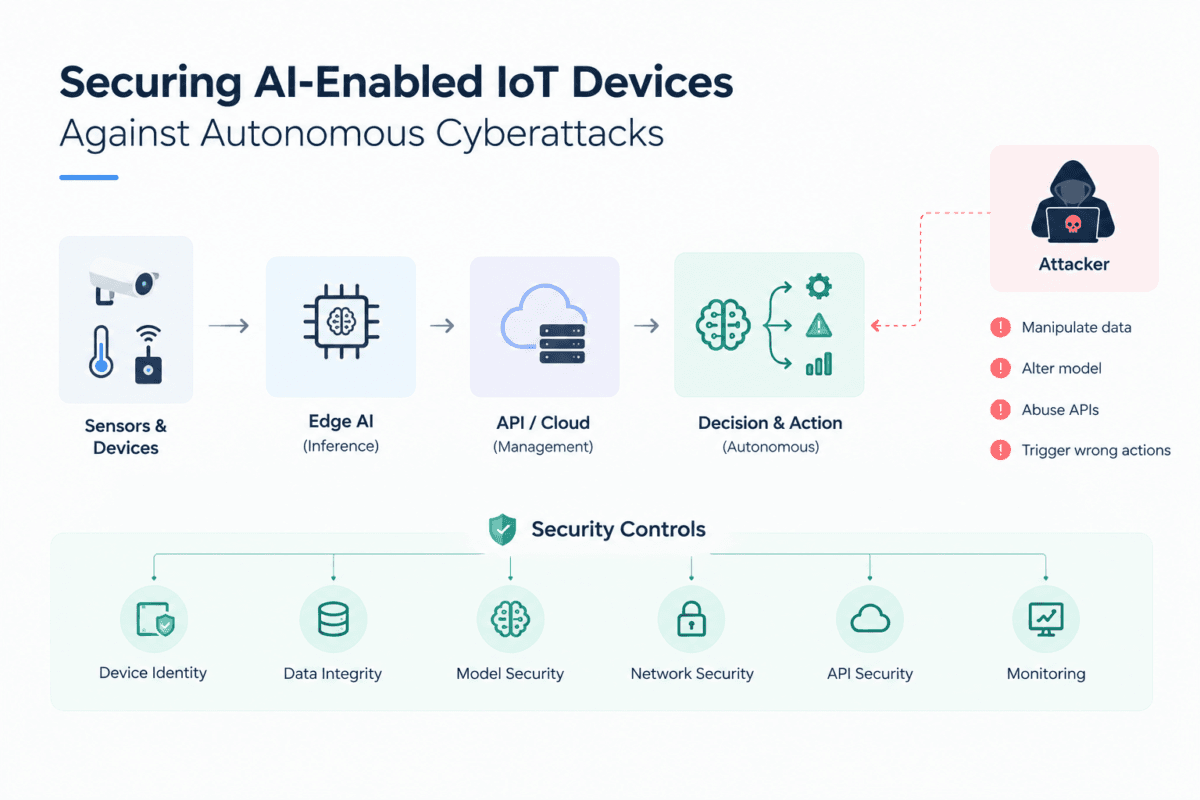
Case Example: A Smart Security Camera
Camera → Image Processing → AI Model → Object Classification → Alert System
A review shouldn’t stop at firmware. Ask:
- Where is the model stored, and who can push updates to it?
- Are updates signed? Concretely:
python
# Device-side verification before loading a new model
def load_model_update(model_file, signature, trusted_public_key):
if not verify_signature(model_file, signature, trusted_public_key):
raise SecurityError(“Untrusted model update rejected”)
load(model_file)
- Can someone remotely lower the confidence threshold (e.g., from 0.85 to 0.99) so real detections get silently dropped as “low confidence”?
- Are inference logs write-once / tamper-evident (e.g., hashed and chained, similar to a lightweight blockchain log)?
Protecting Model Integrity
Approved Model → Signed & Hashed → Verified on Device → Deployed → Monitored at Runtime
python
import hashlib
def verify_model_integrity(model_bytes, expected_hash, signature, pubkey):
actual_hash = hashlib.sha256(model_bytes).hexdigest() if actual_hash != expected_hash:
raise IntegrityError(“Model hash mismatch — possible tampering”)
if not crypto_verify(signature, expected_hash, pubkey):
raise IntegrityError(“Invalid signature — reject update”)
return True
Add hardware-backed verification (TPM/secure enclave)
so even a rooted device can’t be forced to run an unsigned model, and maintain an SBOM (software bill of materials) equivalent for models — version, training data source, hash, and approval history — so you can trace exactly what’s running where.
Protecting the Data Feeding the Model
For a predictive maintenance system reading temperature, vibration, and rotation speed: if only one signal moves while the others stay flat, that’s suspicious.
python
def cross_sensor_anomaly_check(temp_delta, vibration_delta, current_delta, threshold=0.3):
# These signals normally move together under real physical stress
correlation = compute_correlation([temp_delta, vibration_delta, current_delta])
if temp_delta > threshold and correlation < 0.4:
flag_alert(“Isolated temperature spike — possible sensor tampering”)
Other defenses: sensor authentication (each sensor signs its readings with a device key), timestamp validation (rejects replayed old readings), and baseline anomaly detection trained on normal multi-sensor behavior.
Why Edge AI Needs Extra Protection
IoT Sensors → Edge Device (runs local AI model) → Decision → Cloud Platform
Compromising the edge device can expose sensor data, the model file itself, cached API tokens, and Wi-Fi/network credentials — all in one place. Treat it like a server, not a sensor: full disk encryption for model files, hardware root of trust for boot integrity, and no long-lived credentials cached in plaintext.
Locking Down APIs
python
# Bad: one powerful service identity for every device
headers = {“Authorization”: f”Bearer {GLOBAL_ADMIN_TOKEN}”}
# Better: least-privilege, per-device, scoped, short-lived token
headers = {“Authorization”: f”Bearer {device_scoped_token}”}
# token scope = [“telemetry:write”]
only — cannot touch model-management endpoints
Check token lifetime, per-device scoping, and whether a telemetry-only device can accidentally reach /admin/model-update endpoints.
Monitoring Behavior, Not Just Uptime
Signal | Possible Concern |
Unexpected model hash change | Unauthorized model deployment |
New outbound connection to unfamiliar IP | Command-and-control activity |
Sudden shift in classification confidence distribution | Data poisoning or adversarial input |
Repeated auth failures | Credential attack |
Unusual API call sequence (e.g., telemetry device calling admin routes) | Stolen or misused token |
IoT device reaching an OT subnet | Possible lateral movement |
A simple behavioral rule example:
python
if device.role == “telemetry_sensor” and api_call.endpoint.startswith(“/admin”):
raise_alert(f”Role violation: {device.id} attempted admin access”)
Device Identity
Give every device its own certificate and key instead of a shared fleet-wide credential — so compromising one device doesn’t compromise the whole fleet. This aligns with NIST SP 800-213, which recommends establishing trust during onboarding, before a device ever gets network credentials.
The IT/OT Risk
IoT Sensor → Edge AI Gateway → Industrial Network → SCADA/OT System
Map attack paths, not just vulnerabilities: what can this device reach, what trusts it, and can it influence a real industrial decision (like a valve, motor, or safety interlock)?
Quick-Start Checklist
- Inventory every AI device and its exact model version/hash.
- Sign and verify every model update cryptographically before it loads.
- Segment IoT and OT networks.
- Give every device a unique identity — no shared credentials.
- Apply least-privilege, scoped, short-lived API tokens.
- Monitor model behavior and confidence drift, not just uptime.
- Test against adversarial inputs and poisoning, not just CVE scans.
Reference MITRE ATLAS, OWASP ML Security Top 10, and NIST SP 800-213 rather than building controls from scratch.
Final Takeaway
AI is making IoT devices more capable and more autonomous — so IoT security has to grow up with it. It’s no longer enough to ask if firmware is patched. Teams now need to keep asking: who is this device, what data is it trusting, which model is it running, and what happens if any of that gets manipulated? Securing the intelligence behind the device is becoming just as critical as securing the hardware itself.