
VAPT Services Chennai: A Technical Guide to Vulnerability Assessment and Penetration Testing
A security vulnerability does not automatically mean an organization can be compromised.
An exposed service may have a known CVE. A web application may contain an access-control weakness. An employee account may have excessive privileges. A cloud storage bucket may be misconfigured.
The important question is:
Can an attacker chain these weaknesses together to gain unauthorized access, escalate privileges, move laterally, or access sensitive data?
This is where Vulnerability Assessment and Penetration Testing (VAPT) becomes valuable.
VAPT combines automated vulnerability discovery with manual security testing to identify, validate, and prioritize exploitable weaknesses across an organization’s attack surface.
For businesses in Chennai and across India, VAPT can provide technical visibility into network infrastructure, web applications, APIs, cloud environments, endpoints, Active Directory, and externally exposed assets.What Are VAPT Services and How Do They Work?
VAPT consists of two closely related activities.
Vulnerability Assessment focuses on identifying potential security weaknesses using a combination of automated scanners, configuration reviews, asset discovery, and security testing.
Penetration Testing validates whether identified vulnerabilities can actually be exploited under controlled conditions.
For example, a scanner may report:
“Outdated Apache version detected — potential vulnerability.”
A penetration tester does not simply accept that finding. They investigate the installed version, configuration, exposed modules, applicable CVEs, exploitability, compensating controls, and potential attack path.
This helps determine whether the vulnerability represents an actual security risk.
A comprehensive VAPT engagement can assess:
- External network infrastructure
- Internal networks
- Web applications
- Mobile applications
- REST and GraphQL APIs
- Cloud infrastructure
- Active Directory
- Authentication mechanisms
- VPN and remote-access services
- Firewalls and exposed services
- Servers and endpoints
What Does a Technical VAPT Assessment Cover?
The exact scope depends on the organization’s infrastructure and threat model.
Network VAPT
Network penetration testing begins by identifying externally exposed assets, ports, protocols, services, and operating systems.
Testers may investigate:
- Open ports and unnecessary services
- Weak or outdated protocols
- Service misconfigurations
- Vulnerable software versions
- Weak authentication mechanisms
- SSL/TLS configuration
- Firewall rule weaknesses
- Remote-access services
- Network segmentation
- Privilege escalation opportunities
For internal testing, the assessment can go further by examining whether a compromised workstation can be used to access other systems.
A typical attack path could look like:
Initial Access → Credential Discovery → Privilege Escalation → Lateral Movement → Domain Compromise
This type of attack-chain analysis is often more valuable than looking at individual vulnerabilities in isolation.
Web Application VAPT
Web applications should be tested against common application-layer vulnerabilities as well as application-specific business logic.
Testing may include:
- Broken access control
- Authentication weaknesses
- Session-management issues
- SQL injection
- Cross-site scripting
- Server-side request forgery
- Insecure file upload
- Security misconfiguration
- Sensitive information exposure
- Rate-limit weaknesses
- Business-logic vulnerabilities
Testing should be aligned with established security frameworks such as the OWASP Web Security Testing Guide and OWASP Top 10.
For example, if a normal user can modify an API request and access another user’s invoice by changing an object identifier, the issue may represent an authorization failure rather than a simple input-validation problem.
The technical finding is important, but the business impact is what determines its priority.
API Security Testing
APIs frequently expose functionality that is not directly visible through the application’s user interface.
A VAPT assessment can test:
- Authentication and token handling
- Authorization controls
- Object-level authorization
- Excessive data exposure
- Mass assignment
- Rate limiting
- Input validation
- API endpoint enumeration
- JWT implementation
- OAuth flows
- API versioning
- Error handling
For example, an API may correctly authenticate a user but fail to verify whether that user is authorized to access a requested resource.
That creates a situation where:
Authentication succeeds → Authorization fails → Unauthorized data becomes accessible
Cloud Security Testing
Cloud environments introduce a different set of security risks.
Testing may examine:
- IAM policies
- Excessive permissions
- Publicly accessible resources
- Security groups
- Storage permissions
- Encryption settings
- Logging and monitoring
- Network segmentation
- Secrets management
- Exposed management interfaces
- Cross-account access
For AWS environments, for example, an assessment may review IAM roles and policies, S3 access controls, security groups, VPC configuration, and other security-relevant services.
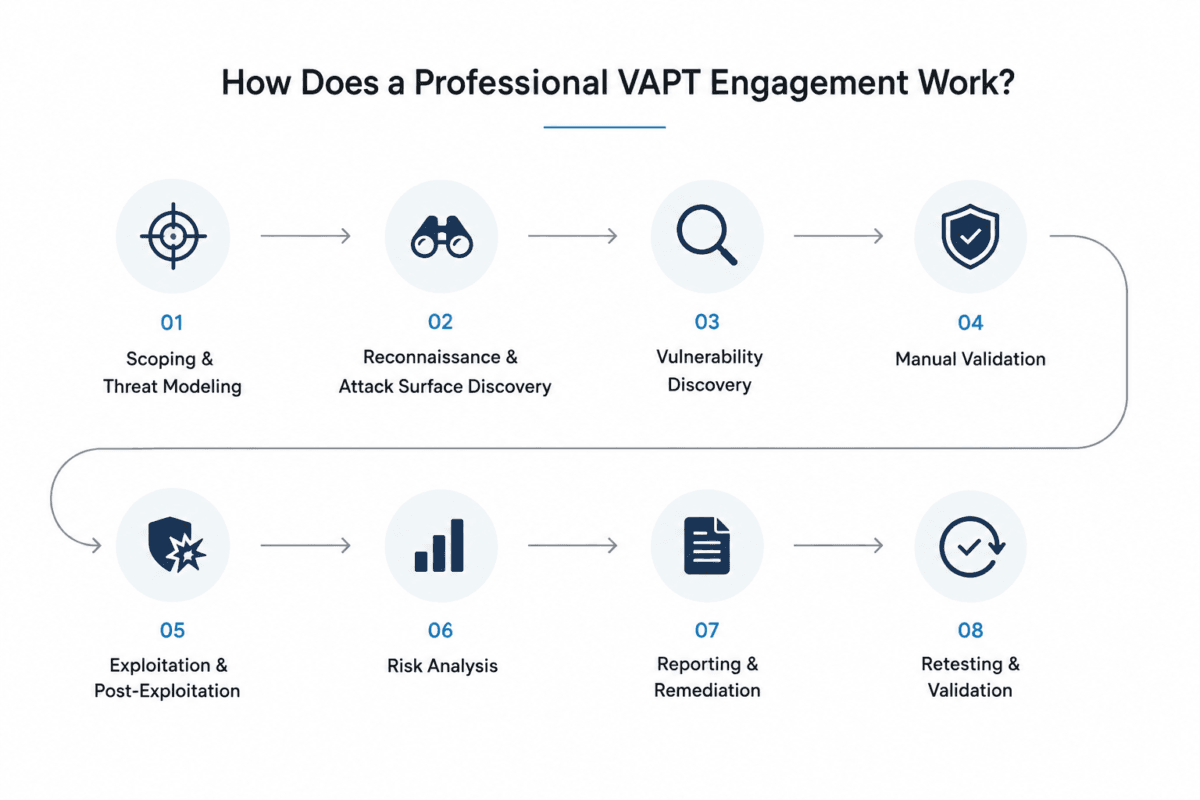
The objective is to identify configurations that could allow an attacker to move from a compromised identity or workload toward higher-value cloud resources.How Does a Professional VAPT Engagement Work?
A technical VAPT engagement generally follows a structured methodology.
- Scoping and Threat Modeling
Before testing begins, the security team defines:
- In-scope assets
- Out-of-scope assets
- Testing methodology
- Authentication requirements
- Testing windows
- Production restrictions
- Emergency contacts
- Rules of engagement
Threat modeling can also help identify the systems and attack paths that deserve additional attention.
- Reconnaissance and Attack-Surface Discovery
The tester identifies the organization’s externally visible attack surface.
This can include:
- Domains and subdomains
- IP addresses
- Open ports
- Web applications
- APIs
- Cloud endpoints
- Remote-access services
- Technology stacks
The objective is to understand what an attacker can discover before authentication.
- Vulnerability Discovery
Automated tools can identify known vulnerabilities, outdated components, weak configurations, and potentially vulnerable services.
Findings may be mapped against identifiers such as CVE and scored using CVSS.
However, a CVSS score alone should not determine remediation priority.
An otherwise high-scoring vulnerability on an isolated development server may represent less immediate business risk than a medium-severity authorization flaw exposing customer information.
- Manual Validation
This is where professional penetration testing becomes significantly different from automated vulnerability scanning.
Testers manually validate findings and investigate attack paths.
For example:
Internet-facing vulnerability → Initial foothold → Local privilege escalation → Credential access → Internal discovery
The tester evaluates whether these stages can realistically be chained together.
- Exploitation and Post-Exploitation Testing
Where permitted by the rules of engagement, testers may perform controlled exploitation to demonstrate business impact.
Post-exploitation activities can include examining:
- Privilege levels
- Accessible systems
- Credential exposure
- Network reachability
- Sensitive files
- Lateral movement possibilities
Testing should remain controlled and should avoid unnecessary modification or destruction of production data.
- Risk Analysis
Each confirmed vulnerability should be evaluated using both technical severity and business context.
A useful risk model considers:
Risk = Likelihood × Impact
Factors can include:
- Exploitability
- Authentication requirements
- Asset exposure
- Data sensitivity
- Privilege level
- Business criticality
- Existing security controls
This provides management with a more realistic remediation priority.
- Reporting and Remediation
A technical VAPT report should provide enough information for security and engineering teams to reproduce and fix the issue.
A finding may include:
- Vulnerability title
- Affected asset
- Severity
- CVE/CVSS where applicable
- Technical description
- Attack scenario
- Evidence
- Business impact
- Remediation recommendation
- References
A separate executive summary can translate these findings into business risk for CIOs, CTOs, and CISOs.
- Retesting
After remediation, testers should verify whether the vulnerability has actually been resolved.
Retesting should determine:
- Whether the original vulnerability is fixed
- Whether the remediation introduced another weakness
- Whether the original attack path remains possible
- Whether compensating controls are functioning as expected
This creates a complete security validation cycle:
Discover → Validate → Remediate → Retest
Why Should Chennai Businesses Invest in VAPT?
Modern organizations operate across cloud platforms, SaaS applications, remote-access systems, APIs, endpoints, and traditional infrastructure.
This creates a constantly changing attack surface.
Find Exploitable Vulnerabilities
VAPT helps distinguish between vulnerabilities that merely exist and vulnerabilities that can create realistic attack paths.
Identify Attack-Chain Opportunities
Attackers rarely rely on a single vulnerability.
A relatively weak vulnerability can become serious when combined with:
- Stolen credentials
- Excessive privileges
- Poor network segmentation
- Weak endpoint controls
- Misconfigured cloud permissions
VAPT can help identify these combinations.
Reduce Attack Surface
Testing can reveal unnecessary exposed services, outdated components, weak authentication mechanisms, and configuration issues that increase exposure.
Improve Remediation Prioritization
Instead of attempting to fix every vulnerability simultaneously, organizations can prioritize vulnerabilities based on exploitability, asset criticality, and business impact.
Support Security and Compliance Programs
VAPT can provide technical evidence that security controls are being tested and validated.
Organizations operating in regulated sectors should also align their testing methodology and reporting with applicable regulatory and industry requirements.How to Choose the Right VAPT Company in Chennai
When evaluating VAPT providers, businesses should look beyond automated scanning capabilities.
Evaluate Technical Expertise
Ask whether testers have practical experience with:
- Network penetration testing
- Web application security
- API security
- Active Directory
- Cloud security
- Privilege escalation
- Authentication attacks
- Manual exploitation
Relevant certifications may include OSCP, CEH, GPEN, and eWPT, depending on the assessment scope.
Ask About Manual Testing
A provider that only delivers vulnerability scanner output is not providing the same depth as a manual penetration-testing engagement.
Ask specifically:
How are vulnerabilities manually validated?
Do you test business logic?
Do you analyze attack chains?
Is privilege escalation included?
Review the Reporting Methodology
The report should clearly differentiate between:
- Informational observations
- Potential vulnerabilities
- Confirmed vulnerabilities
- Exploitable weaknesses
- Critical attack paths
Technical evidence should be sufficient for internal security teams to understand the finding and begin remediation.
Check Retesting Procedures
Ask whether remediation validation is included and how previously identified vulnerabilities are tracked through closure.VAPT Services Chennai: What Should Businesses Expect?
A VAPT engagement should produce more than a vulnerability count.
A mature engagement should provide visibility into:
What is exposed?
What is vulnerable?
What can actually be exploited?
How could an attacker move through the environment?
What data or systems could be affected?
What should be fixed first?
The timeline depends on scope and complexity. A web application with a limited attack surface may require significantly less testing time than a large enterprise environment involving external infrastructure, internal networks, APIs, cloud environments, and Active Directory.
Production testing should also be carefully controlled through defined rules of engagement to minimize operational impact.Final Takeaway
VAPT should not be treated as a simple vulnerability-scanning exercise.
The real objective is to understand how technical weaknesses translate into realistic attack paths and business risk.
For organizations in Chennai, a technically rigorous VAPT assessment can combine automated discovery, manual exploitation, authentication testing, privilege escalation, attack-chain analysis, risk prioritization, remediation guidance, and retesting.
The most important outcome is not the number of vulnerabilities discovered.
It is knowing which weaknesses an attacker could realistically exploit—and whether your organization can stop the attack before it reaches critical systems or sensitive data.