
Why CVSS Scores Alone Cannot Prioritize VAPT Findings
A VAPT assessment can produce dozens of vulnerabilities, each with a different CVSS score. It is tempting to simply fix the 9.8s first and work down the list.
But real-world attacks rarely happen that way.
Attackers don’t care about the score itself. They care about what they can access, how easily they can exploit it, and where it can take them next.
That is why CVSS should be treated as a starting point, not the complete risk picture.
CVSS Shows Severity, Not Business Risk
Consider a critical vulnerability on an isolated development server and a medium-severity vulnerability on an internet-facing application.
The first might have a CVSS score of 9.8, but the second could provide access to customer data or an internal API.
The vulnerability score is the same wherever the vulnerability exists. The risk is not.
During VAPT, factors such as asset criticality, network exposure, sensitive data, user privileges, and existing security controls need to be considered alongside CVSS.
Attack Chaining Changes the Picture
One of the biggest reasons CVSS alone is not enough is attack chaining.
Imagine a VAPT assessment identifies:
Broken Access Control
        ↓
Internal API Access
        ↓
Exposed Service Token
        ↓
Privileged Application
        ↓
Sensitive Data
Each finding might have a moderate severity rating.
Together, they create a realistic path to compromise.
This is why VAPT teams need to look beyond individual vulnerabilities and understand what an attacker can achieve by combining them.
Exploitability Matters
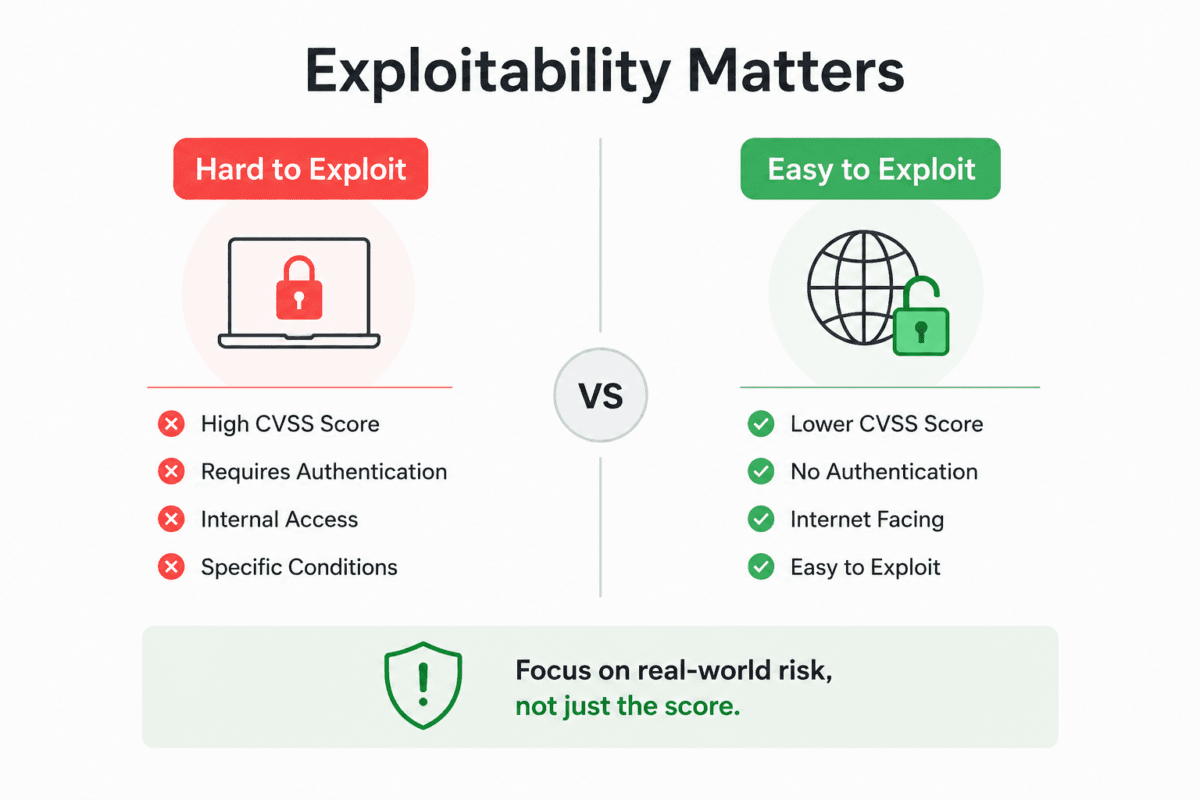
A high CVSS vulnerability may require authentication, internal network access, or a specific configuration that does not exist in your environment.
Meanwhile, a lower-scored vulnerability might be:
- Internet-facing
- Unauthenticated
- Easy to exploit
- Supported by public exploit code
- Connected to a critical system
In practice, the second vulnerability may deserve faster remediation.
The key question is not simply “How severe is it?” but “How realistic is exploitation in our environment?”
Asset Criticality Changes Priority
The same vulnerability can have completely different consequences depending on where it exists.
For example:
Development server
- Internal only
- No sensitive data
- Isolated from production
Production application
- Internet-facing
- Handles customer information
- Connected to internal APIs
- Uses privileged service accounts
Even if both systems have the same vulnerability, the production system should normally receive higher attention.
Threat Intelligence Also Matters
Risk can change quickly when a vulnerability starts being actively exploited.
A vulnerability that was considered a normal patching task yesterday may become an urgent issue once:
- Public exploit code becomes available
- Attackers begin targeting it
- Automated exploitation appears
- Your exposed technology matches the attack
This is why vulnerability prioritization should consider current threat activity, not just the original CVSS rating.
A Better Way to Prioritize VAPT Findings
Instead of ranking findings only by CVSS, security teams can consider:
CVSS
+
Asset Criticality
+
Exploitability
+
Internet Exposure
+
Privilege Impact
+
Data Sensitivity
+
Threat Activity
+
Attack Path
↓
Actual Remediation Priority
This approach helps separate vulnerabilities that simply look severe from those that could realistically lead to a breach.
Final Takeaway
CVSS is a useful way to measure vulnerability severity, but it should not be the only factor used to decide what gets fixed first. Exploitability, asset criticality, exposure, privilege level, threat activity, and attack paths provide the context needed to understand real-world risk.
For organizations looking to identify and prioritize these risks effectively, a professional VAPT service in India can help uncover vulnerabilities that automated scoring alone may overlook.
The goal isn’t simply to fix the highest CVSS score—it is to identify the weaknesses that could realistically lead to a security breach and address them first.