
Why Security Teams Miss Critical Alerts Even When They Have the Right Tools
Modern organizations can have endpoint protection, cloud security platforms, identity
controls, firewalls, SIEM systems and multiple threat detection tools operating at the same
time. Yet having more security tools does not automatically mean that every important
security event will be detected and investigated.
The challenge often begins when thousands of alerts are generated across different
environments, while the security team has to determine which events represent a genuine
threat.
A suspicious login may appear harmless on its own. An unusual PowerShell execution may
look like another endpoint event. A new administrator account may not immediately appear
dangerous.
But when these events are connected, they can reveal a much larger attack pattern.
This is where SOC monitoring services become important—not simply for collecting alerts,
but for continuously identifying, correlating and investigating signals that could indicate an
active security incident.
The Real Problem Is Not Always a Lack of Security Tools
Security teams often invest in multiple technologies to improve their defensive capabilities.
The challenge is that these tools operate within different security layers.
An endpoint platform may detect suspicious process activity.
An identity platform may record an unusual login.
A cloud platform may report an unexpected configuration change.
A firewall may record unusual outbound traffic.
Individually, these events may not appear critical.
The problem emerges when there is no effective mechanism for connecting them.
Consider a simplified scenario:
08:42 — An employee account authenticates from an unusual location.
08:47 — A new authentication token is created.
08:51 — A privileged resource is accessed.
08:56 — An unusual command is executed on an endpoint.
Looking at these events separately can produce four unrelated alerts.
Looking at them together may reveal a potential account compromise followed by privilege
escalation and endpoint activity.
The difference is not necessarily another security tool.
It is context.
Alert Volume Can Hide the Signal That Matters
Security monitoring environments generate alerts for many legitimate reasons.
Administrators make configuration changes. Employees access systems from different
locations. Applications create automated connections. Cloud services generate background
activity.
Security teams therefore need to distinguish between:
•Expected activity
•Suspicious activity
•High-risk activity
•Confirmed malicious activity
This becomes difficult when alerts are reviewed individually.
A high-priority alert can also lose attention when it appears alongside hundreds of lower-
priority events.
This is one reason effective security monitoring services need more than alert collection.
They require processes for prioritization, correlation and investigation.
A Critical Alert Rarely Exists in Isolation
Attackers do not necessarily generate one obvious event that announces an intrusion.
An attack can develop through a sequence of smaller activities.
For example:
Initial access → Credential activity → Privilege escalation → Internal movement →
Data access
Each stage can generate different signals across different security systems.
An endpoint may see process execution.
An identity platform may see authentication anomalies.
A network security system may observe unusual connections.
A cloud environment may record unexpected resource access.
If these signals remain separated, the security team may see individual alerts rather than the
broader attack path.
A mature monitoring approach attempts to establish the relationship between those events.
The Difference Between Alerting and Detection
Alerting and detection are not always the same thing.
An alert tells the security team that something happened.
Detection attempts to determine whether those events represent a meaningful security threat.
For example:
Alert: User account accessed a resource from an unusual location.
The next questions could include:
•Was the login consistent with the user’s normal activity?
•Was a new device involved?
•Were multiple authentication attempts recorded?
•Did the account access sensitive resources afterward?
•Was there unusual endpoint activity?
•Did the account perform actions it normally does not perform?
The individual alert provides the starting point.
The surrounding evidence provides the context.
This distinction is central to effective threat detection and cybersecurity monitoring.
Why Context Matters During an Investigation
Consider an endpoint alert showing that a command-line utility was executed.
That activity may be legitimate.
But suppose the same endpoint also shows:
•An unusual user authentication
•A newly created scheduled task
•Communication with an unfamiliar external destination
•Access to sensitive files
The significance of the original alert changes.
The command execution is no longer being considered by itself.
It becomes one part of a larger sequence.
This type of contextual investigation can help security teams move from:
“Something unusual happened.”
to:
“These events may be related and require investigation.”
That shift can significantly improve how security teams handle security alerts.
Where Security Operations Teams Commonly Face Gaps
Even organizations with strong security technology can encounter monitoring gaps.
1. Too many disconnected alerts
Different security products may generate their own alerts without providing enough context
across systems.
2. Limited continuous monitoring
Security events can occur outside normal working hours, during weekends or when internal
teams are focused on other priorities.
3. Insufficient investigation capacity
Finding an alert is only the beginning. Someone still needs to determine what happened,
whether it matters and what should happen next.
4. Lack of attack-chain visibility
An attacker may move across identity, endpoint, network and cloud environments.
Monitoring only one layer can leave important parts of the activity unseen.
5. Alert prioritization challenges
Not every alert deserves the same level of attention. Without effective prioritization,
important events can compete with large volumes of routine activity.
Security Monitoring Needs to Follow the Attack, Not Just the Alert
A useful security monitoring strategy should look beyond individual products.
It should consider how activity moves across the environment.
For example:
Identity event
↓
Endpoint activity
↓
Network communication
↓
Cloud resource access
↓
Potential data exposure
This approach provides security teams with a broader view of what may be happening.
It also allows organizations to investigate relationships between events instead of treating
every alert as an isolated incident.
This is one of the key areas where managed SOC services can support organizations that
need continuous security monitoring and investigation capabilities without relying entirely on
an internal team.
What Business Leaders Should Look for in Security Monitoring
For business leaders, the question should not simply be:
“How many security alerts did our tools generate?”
More useful questions include:
•Are critical security events being identified quickly?
•Can the security team connect events across different environments?
•Who investigates high-risk alerts?
•What happens when an incident begins outside business hours?
•Can the organization reconstruct the sequence of events?
•Are alerts being converted into actionable security decisions?
•How quickly can the organization move from detection to response?
These questions shift the discussion from security technology ownership to security
visibility and operational readiness.
Building a More Effective Detection Process
Organizations can strengthen their monitoring approach by focusing on several areas.
Centralized visibility
Security events from endpoints, networks, cloud environments and identity systems should be
accessible within an investigation workflow.
Event correlation
Related events should be connected to help analysts understand whether separate alerts could
represent one attack sequence.
Risk-based prioritization
High-risk events should receive appropriate attention rather than being treated the same as
routine security notifications.
Continuous monitoring
Security incidents do not necessarily follow business hours. Monitoring processes should
account for activity occurring across the organization’s operating environment.
Investigation and response
Detection should lead to investigation, and investigation should lead to appropriate response
actions when a genuine incident is identified.
Security Tools Are Only One Part of the Security Operation
Security technologies remain essential. Firewalls, endpoint protection, SIEM platforms,
identity controls, cloud security tools and other defensive technologies provide important
visibility.
But technology alone does not guarantee that the right signal will become the right decision.
The effectiveness of a security operation also depends on how those signals are monitored,
correlated, investigated and acted upon.
structured approach to continuous security monitoring, alert investigation and threat
detection.
A Practical Question for Security Leaders
Instead of asking:
“Do we have enough security tools?”
consider asking:
“If a coordinated attack started today, would our security operation recognize the
pattern across our environment?”
The answer depends not only on the technologies deployed, but also on the organization’s
ability to continuously monitor activity, connect security signals and investigate suspicious
behavior.
Effective security monitoring is ultimately about turning fragmented security events into
meaningful decisions.
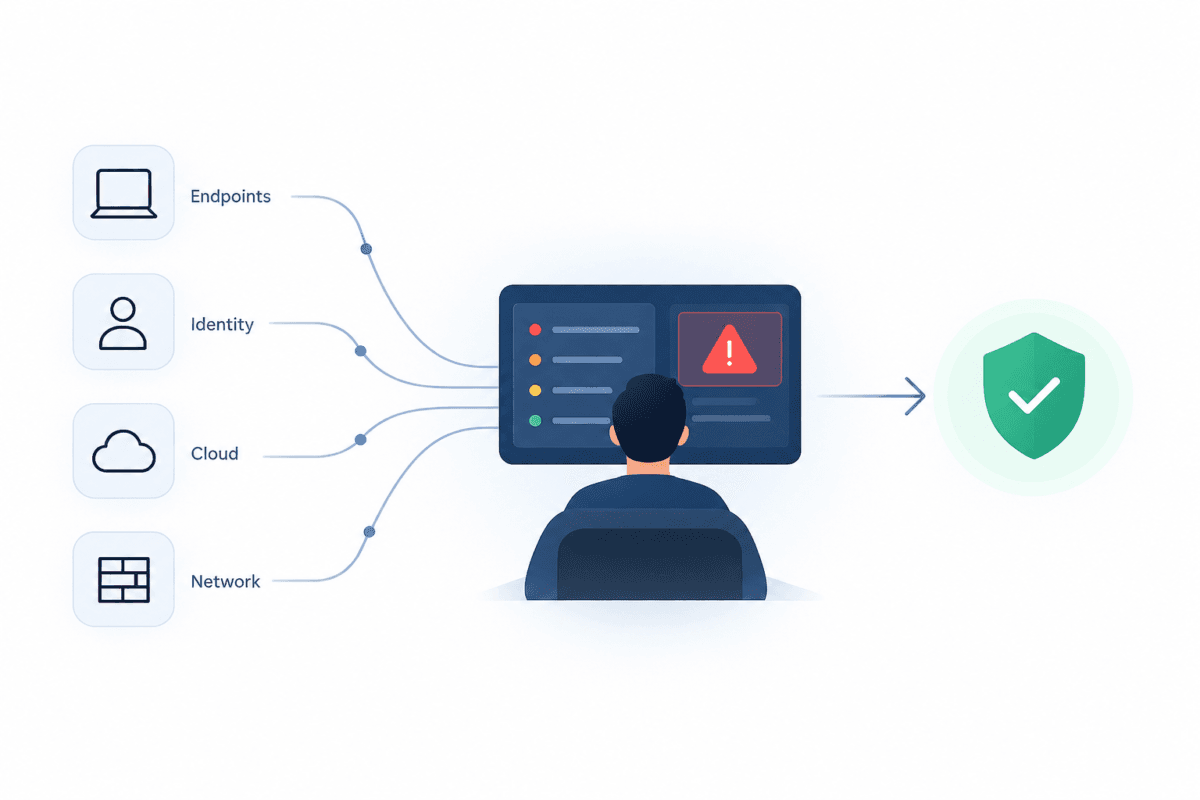
Security Monitoring Is an Operational Capability
Having multiple security tools does not automatically create complete security visibility.
Organizations also need the ability to continuously review alerts, connect activity across
endpoints, identity, network and cloud environments, and determine which events require
investigation.
As environments become more complex, maintaining this level of visibility requires more
than technology. It requires consistent monitoring, skilled investigation and a process for
turning security signals into meaningful decisions.
The real question is not how many alerts an organization receives, but whether it can
recognize the sequence of alerts that actually matters.