
How a Cloaked Injection Helped Attackers Stay Hidden for 11 Days
The following is a composite, illustrative scenario built from common cloaked-injection attack patterns observed across real-world incidents — not a specific documented case or customer environment. Techniques, indicators, and detection methods described are accurate and drawn from how these attacks typically unfold in practice.
The Alert That Didn't Look Suspicious
It started with a single HTTP POST request.
At 02:17 UTC, an internal monitoring dashboard flagged a request containing an unusually long Base64-encoded parameter sent to a customer login API.
Nothing was blocked.
The Web Application Firewall (WAF) classified the request as low risk because its signatures didn’t match any known SQL injection or Remote Code Execution (RCE) patterns.
The application returned HTTP 200 OK.
No alerts were generated.
Day 3: Strange Database Queries
Three days later, database administrators noticed something unusual.
The production SQL server was receiving requests that had never appeared before.
WAITFOR DELAY ’00:00:05′
Some queries suddenly took exactly five seconds to execute.
Others appeared completely normal.
Performance monitoring showed only a slight increase in latency.
Nothing suggested a compromise.
Day 7: Attackers Already Had Access
Threat hunters began reviewing IIS logs.
One request immediately stood out.
Instead of sending obvious SQL injection payloads like:
‘ OR 1=1 —
the attacker submitted:
Y21kPXBvd2Vyc2hlbGwgLWVuYy…
At first glance, it looked like random text.
It wasn’t.
The application decoded the Base64 string before processing it. The decoded payload contained an obfuscated PowerShell command that downloaded additional code from a remote server.
The injection had been cloaked.
Why the WAF Missed It
Traditional security tools rely heavily on signatures. They look for patterns such as:
- UNION SELECT
- xp_cmdshell
- <script>
- OR 1=1
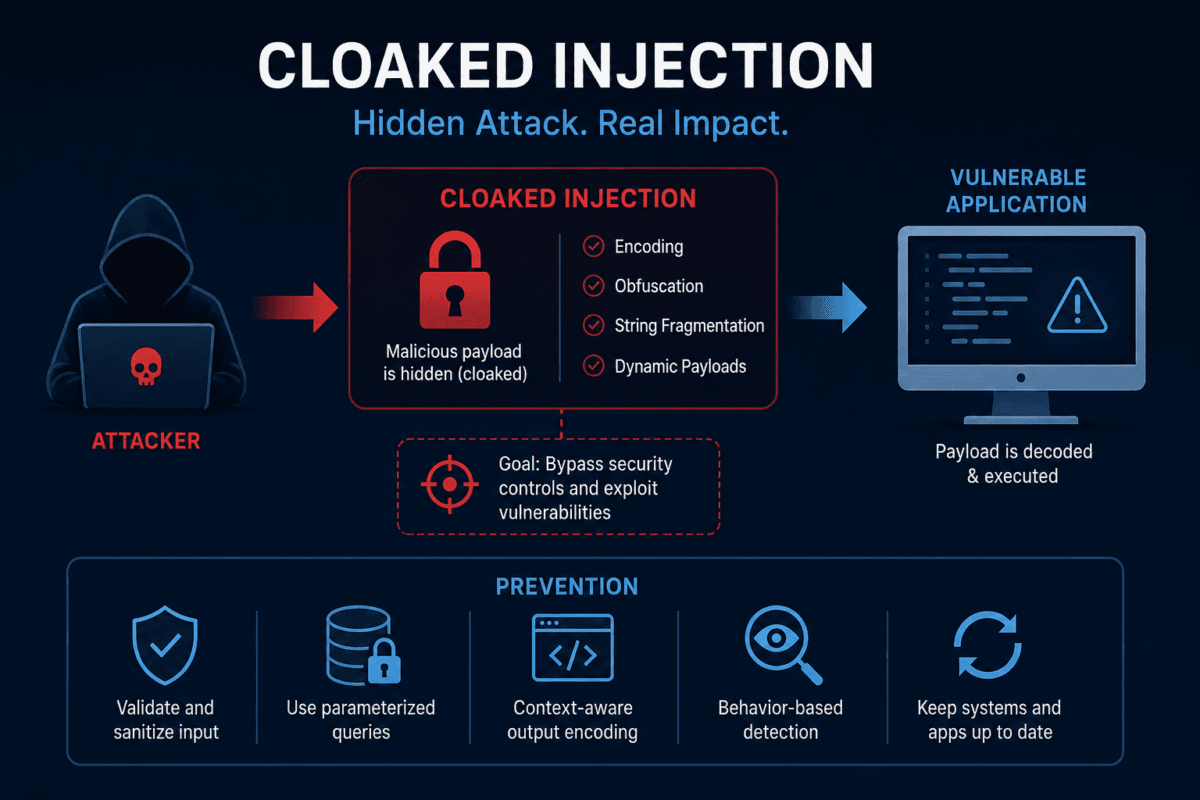
The attacker avoided every signature. Instead, they used:
- Base64 encoding
- Multiple decoding stages
- String concatenation
- Dynamic variable creation
- Runtime PowerShell execution
By the time the payload became readable, it had already passed every perimeter security control.
The Second Stage
Once decoded inside the application, the payload:
- Downloaded a lightweight loader
- Established encrypted outbound communication
- Enumerated Active Directory
- Collected stored credentials
- Moved laterally using legitimate administrative tools
No ransomware appeared. No obvious malware appeared. Instead, the attackers quietly mapped the environment while blending into normal administrative traffic.
Detection Finally Happened
The compromise wasn’t discovered because of the injection. It was discovered because the Security Operations Center (SOC) noticed unusual outbound DNS requests from the application server.
Threat hunters correlated:
- IIS logs
- SQL logs
- PowerShell Operational Logs
- Windows Event IDs
- Network telemetry
The investigation revealed that the original attack had occurred 11 days earlier. The cloaked injection was simply the initial access vector.
Technical Indicators
During analysis, investigators identified several indicators commonly associated with cloaked injection attacks.
Payload characteristics
- Long Base64 strings
- Multiple encoding layers
- High entropy parameters
- Dynamic PowerShell execution
- Encoded JavaScript
Behavioral indicators
- Unexpected outbound HTTPS traffic
- SQL time delays
- Abnormal child processes spawned by IIS
- Encoded PowerShell commands
New scheduled tasks
Why Cloaked Injection Is Becoming More Common
Modern attackers understand that signature-based detection is no longer enough. Instead of creating new exploits, they focus on hiding known payloads until they reach the application. Encoding and obfuscation significantly reduce the likelihood of detection while requiring minimal effort from the attacker.
This technique has been observed across web shells, Magecart campaigns, FakeUpdates (SocGholish), malicious JavaScript injections, and post-exploitation frameworks.
Prevention Requires More Than a WAF
Organizations should combine secure development with behavioral monitoring. Recommended controls include:
- Strict server-side input validation
- Parameterized SQL queries
- Runtime Application Self-Protection (RASP)
- EDR monitoring on web servers
- PowerShell logging
- Network anomaly detection
- Regular penetration testing
- Continuous threat hunting
Detection should focus on behavior, not just payload signatures.
A Different Front Door: Initial Access Through Phishing
This particular scenario started at the application layer — a cloaked injection against a vulnerable API, not a phishing email. It’s worth being clear about that distinction, because application-layer attacks and phishing-based access are different problems requiring different defenses.
That said, initial access vectors vary, and phishing remains one of the most common ways attackers get an initial foothold in the first place: a user clicks a link to what appears to be a trusted site, downloads a fake browser update, or authenticates through a cloned login page. From there, attackers can pursue the same kind of second-stage activity described above — credential collection, lateral movement, quiet reconnaissance — just by a different opening move.
A phishing URL detector wouldn’t have caught the cloaked injection in this scenario — that’s not what it’s built for. But it addresses the other major entry point into the same kind of compromise, which is why organizations generally need both: application-layer defenses for vulnerabilities like this one, and link/URL verification for the phishing vector that leads to the same downstream damage by a different route.
Final Thoughts
Cloaked injection attacks are effective because they exploit both technical vulnerabilities and defensive blind spots. The payload itself may not be new, but by hiding it through encoding and obfuscation, attackers can bypass traditional security controls and remain undetected for days.
Organizations that combine secure coding, behavioral analytics, continuous monitoring, regular threat hunting, and phishing protection are far better equipped to detect these stealthy attacks before they escalate into a full-scale compromise.