
Email Account Compromise: How One Stolen Identity Can Lead to a Large-Scale Data Breach
Introduction
Most organizations invest heavily in protecting servers, endpoints, and networks. Yet many modern cyberattacks begin somewhere much simpler—an email account compromise.
A compromised employee email account can provide attackers with access to sensitive business information without exploiting a single server. From customer records to cloud storage, one trusted identity can become the starting point for a large-scale data breach.
Understanding how attackers move from a compromised email account to data theft helps organizations strengthen their defenses before an incident occurs.
It Starts with an Email
Attackers rarely begin by targeting an organization’s critical infrastructure.
Instead, they target people.
A carefully crafted phishing email, a fake Microsoft 365 login page, or a stolen session token can provide access to a legitimate employee account.
Common initial access techniques include:
- Credential phishing
- Fake login portals
- Session cookie theft
- Password reuse
- Malware or infostealers
- Social engineering
The goal isn’t simply to access an inbox—it’s to obtain a trusted identity inside the organization.
Why One Email Account Matters
An employee email account often provides access to much more than messages.
It may include access to:
- Customer records
- Financial documents
- Contracts
- Internal reports
- Cloud storage
- Collaboration platforms
- Shared drives
- Password reset emails
Because attackers operate using legitimate credentials, their activity may initially appear normal, making identity-based attacks difficult to detect.
Step 1: Account Takeover
After gaining access, attackers typically avoid actions that would immediately raise suspicion.
Instead, they quietly:
- Review recent conversations
- Search for sensitive keywords
- Access shared folders
- Download important attachments
- Explore cloud storage permissions
Some attackers also create hidden mailbox rules to maintain persistence or automatically forward emails.
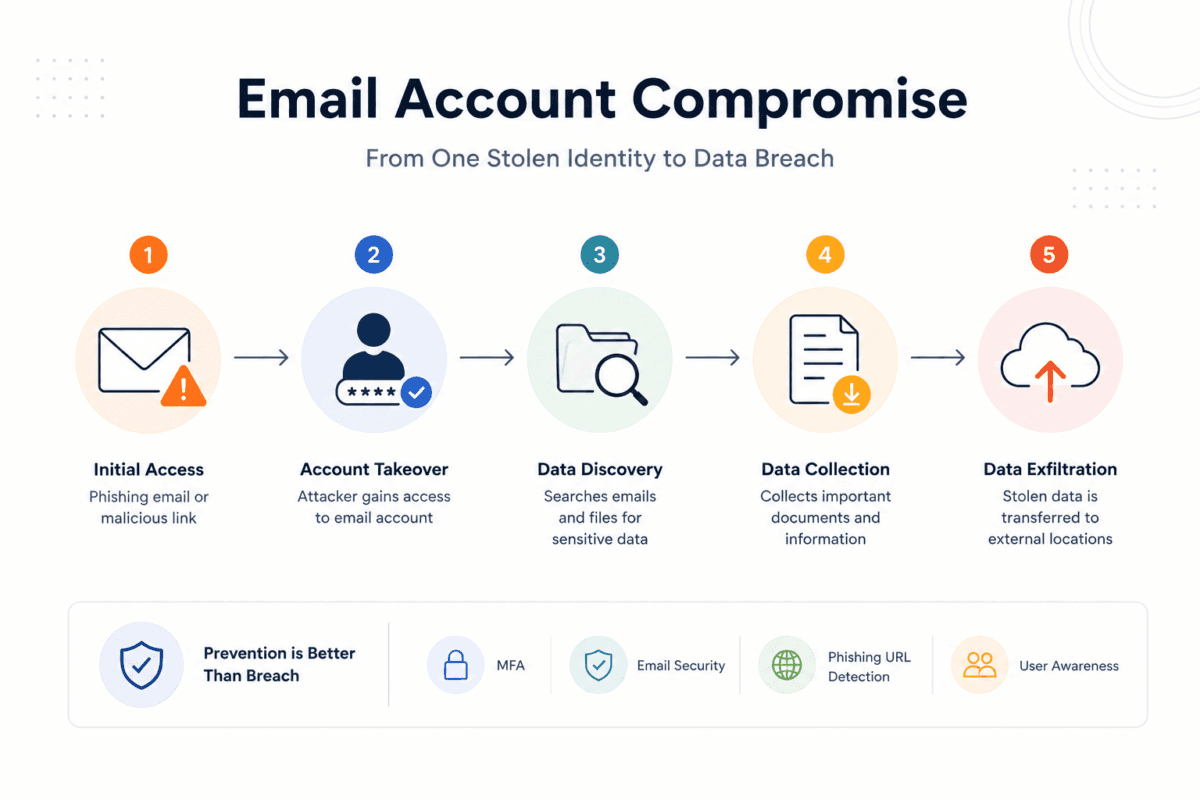
Step 2: Data Discovery
Rather than collecting everything, attackers search for high-value information.
Typical targets include:
- Customer records
- KYC documents
- Financial reports
- Contracts
- Payroll data
- Audit reports
- Confidential project files
Step 3: Data Collection
Once valuable information is located, attackers begin gathering:
- Email attachments
- Cloud storage documents
- Shared folders
- Exported mailboxes
- Internal reports
Depending on the user’s permissions, one account may provide access to thousands of sensitive documents.
Step 4: Data Exfiltration
Finally, attackers transfer the collected data outside the organization.
This may involve cloud storage services, remote servers, or attacker-controlled infrastructure.
Unfortunately, many organizations only discover the compromise after data has already been exfiltrated.
How Security Teams Can Detect Email Account Compromise
Identity-based attacks often leave behavioral indicators before a significant breach occurs.
Security teams should monitor for:
- Logins from unusual locations
- Impossible travel events
- New device registrations
- Unexpected mailbox rule creation
- Large attachment downloads
- Abnormal SharePoint or OneDrive activity
- Unusual authentication patterns
- Large outbound data transfers
Rather than focusing only on successful authentication, defenders should also analyze what users do after they log in.
How to Reduce the Risk
Organizations can reduce the likelihood and impact of an email account compromise by implementing multiple layers of defense:
- Multi-Factor Authentication (MFA)
- Conditional Access policies
- Email security gateways
- Data Loss Prevention (DLP)
- Least privilege access
- Continuous identity monitoring
- User awareness training
- Regular access reviews
Many attacks begin with users unknowingly clicking a malicious login URL that closely mimics a trusted website.
Using a phishing URL detector alongside email security helps identify suspicious links before credentials are entered, reducing the risk of credential theft and account compromise.
Related Solution: Learn how our Phishing URL Detector helps identify malicious URLs before users submit their credentials.
Final Thoughts
Modern data breaches increasingly begin with compromised identities rather than compromised infrastructure.
A single employee email account can provide attackers with access to business-critical information, making identity security a key component of every cybersecurity strategy.
Protecting email accounts requires more than strong passwords. It requires continuous monitoring, user awareness, layered security controls, and proactive detection of suspicious activity before sensitive data leaves the organization.