
Why Security Teams Miss Critical Alerts Even When They Have the Right Tools
Modern cloud environments rarely operate in isolation.
An organization may connect its Microsoft 365 tenant to security platforms, Salesforce to
analytics tools, GitHub to CI/CD pipelines, AWS to monitoring platforms, and cloud
applications to dozens of third-party SaaS services.
These integrations are useful because they allow systems to exchange data and perform
actions automatically.
But the same trust relationship can become an attack path.
How the Trust Relationship Works
A typical integration looks simple:
User → OAuth authorization → Third-party application → API → Cloud resources
During authorization, an application may receive an access token with specific permissions,
such as:
•Read cloud files
•Access email
•Read user profiles
•Modify resources
•Access APIs
•Manage repositories
The application doesn’t necessarily need the user’s password.
Instead, the cloud platform trusts the token and its assigned permissions.
This creates an important security problem:
If the trusted application is compromised, its permissions can potentially be abused
without compromising the user’s password.
The Attack Path
Consider an employee authorizing a legitimate-looking application.
The application requests access through OAuth.
The user approves it.
The identity provider issues an access token.
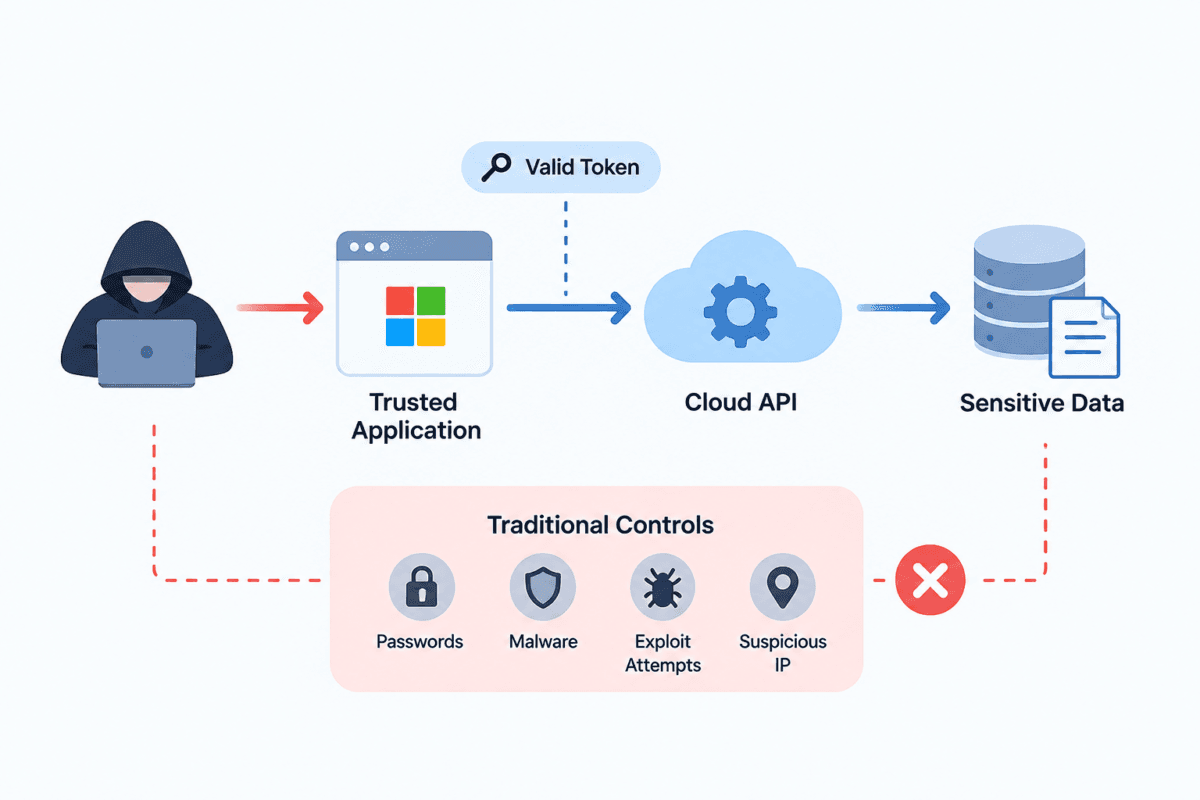
From the cloud platform’s perspective, the request can look legitimate:
User
↓
OAuth Consent
↓
Access Token
↓
Trusted Application
↓
Cloud API
↓
Sensitive Data
An attacker who obtains control of that application, token, or authorization flow may be able
to operate through the same trusted relationship.
The activity can therefore resemble normal API traffic rather than a traditional intrusion.
Why Traditional Controls Can Miss It
Traditional security controls often focus on:
•Password attacks
•Malware
•Exploit attempts
•Suspicious IP addresses
•Unauthorized login attempts
But trusted integrations create a different problem.
The attacker may already have:
Valid authentication + valid token + valid application permissions
There may be no obvious vulnerability to exploit.
This makes detection more dependent on behavioral signals such as:
•Unusual OAuth consent
•New applications being authorized
•Excessive API activity
•Unusual token usage
•Access from unexpected locations
•Sudden access to large amounts of data
•Permission changes
•New service principals
•Abnormal application-to-application communication
The Real Problem: Excessive Trust
The biggest risk isn’t necessarily the integration itself.
It is how much trust the integration receives.
For example, an application that only needs to read calendar information should not receive
broad access to:
•Mailboxes
•Cloud storage
•User directories
•Administrative APIs
This is where least privilege becomes important.
Permissions should match the application’s actual business requirement.
A useful security model is:
Need → Permission → Scope → Monitoring
If an integration requires access to one resource, its permissions should not automatically
extend across the entire cloud environment.
What Security Teams Should Monitor
Cloud security teams should maintain visibility into the entire integration layer.
Important areas include:
OAuth applications
Track newly authorized applications, requested scopes and authorization changes.
Service principals
Review which applications have identities inside the cloud environment and what
permissions they possess.
API activity
Look for unusual API calls, access volume and abnormal resource discovery.
Token behavior
Monitor unusual token creation, usage patterns and geographic anomalies.
Permission changes
Alert on privilege escalation, newly granted administrative permissions and changes to
application roles.
Third-party dependencies
Review whether connected applications themselves have adequate security controls.
The Bigger Cloud-Security Issue
A cloud environment can be technically well configured and still contain a dangerous attack
path.
For example:
Compromised employee → trusted OAuth application → excessive permissions → cloud
API → sensitive data
None of these steps necessarily requires exploiting a vulnerable server.
The attacker is abusing identity, authorization and trust relationships that the cloud
environment was designed to support.
That is why cloud security cannot focus only on misconfigured storage, exposed ports or
vulnerable workloads.
Identity relationships, application permissions and third-party integrations are part of
the cloud attack surface too.